Azure Data Engineering Course: Build a Pipeline That Survives a Failed Run
Subham Chand
Sep 28, 20265 min read7 views
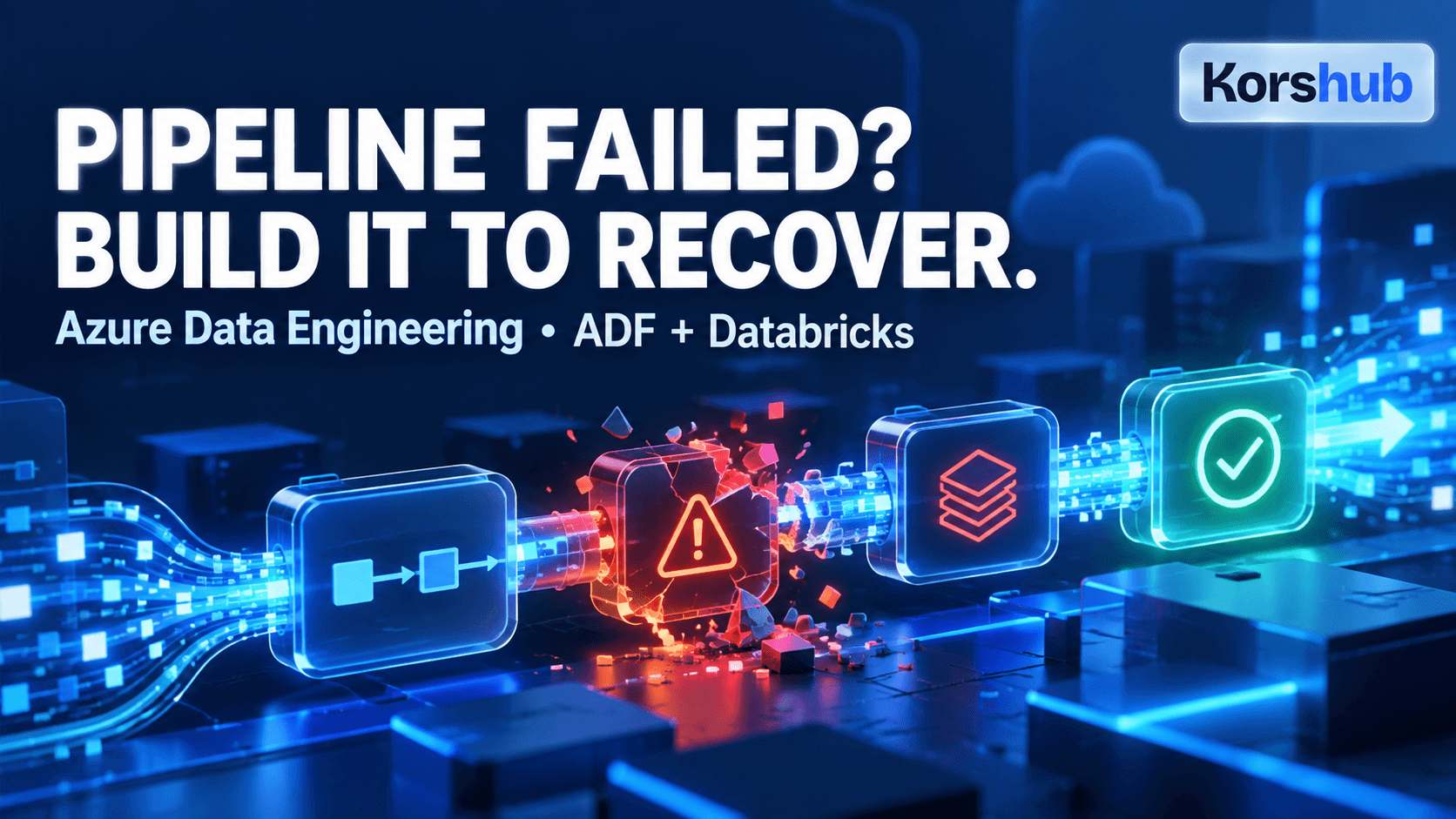
A dashboard can look perfect on Monday and quietly show duplicate orders on Tuesday. The difference is often a data pipeline that worked once but couldn’t recover cleanly when a source file arrived late or a job failed halfway through.
If you’re considering an Azure data engineering course, learn the tools as parts of that one problem. The Azure Data Engineering Masters course on Korshub covers SQL, Python, Spark, Azure Data Factory (ADF), Databricks, cloud storage, security, and capstone work. Here’s how to turn that broad syllabus into a project you can explain and test.
Advertisement
What an Azure data engineering course should help you build
Imagine an online store sending daily order files and product updates. Your task is to produce a trustworthy sales table for analysts. A useful pipeline must ingest the data, validate it, clean and join it, publish the result, and make failures visible. Running a notebook once is only a small part of that job.
Give each component a clear responsibility. ADF can schedule and coordinate a batch ingestion workflow. Azure storage can hold raw files and processed outputs. Databricks and PySpark can transform larger datasets, while SQL helps you inspect, join, and verify the tables. Monitoring tells you whether the work finished and whether the output still makes sense.
That division matters more than memorizing product names. When a run fails, you should know which step owns the failure and whether rerunning it could create duplicates.
An Azure Data Factory and Databricks project you can actually explain
Start with a small daily order dataset and a product catalogue. Make the example realistic by including a duplicate order, a missing product ID, a late file, and a corrected order. Keep a note of the expected output before you write the transformation.
Ingest. Land each source in a raw area with its arrival date and source name. Use an ADF pipeline to coordinate the movement and record the run outcome. Preserve the original input so you can investigate or replay a bad batch later.
Transform. In Databricks, use PySpark to standardize timestamps, reject or quarantine invalid rows, deduplicate by a documented business key, and join orders to products. Make the rule for corrected orders explicit: should the newest version replace the earlier record, or should both remain as events? SQL queries can then check row counts, totals, and unexpected nulls.
Publish and recover. Write a clean table for reporting. Run the same input twice: do totals double? Then interrupt the workflow after ingestion and rerun it. A useful portfolio project shows what happens during recovery, not just a successful screenshot. For incremental loads, track which files or records were processed and make writes safe to repeat.
Operate. Add a failure alert, a basic data-quality threshold, and a run log that identifies the input batch. Record elapsed time and the resources used. A pipeline that is correct but too expensive or difficult to diagnose still needs work.
This is a suggested practice project, not a claim that the course supplies this exact dataset or these exact safeguards. The point is to connect its listed ADF, Databricks, SQL, Python, and capstone topics to a single outcome.
Learn SQL and Python before tuning Spark
Spark can process large data, but distributed code won’t fix a weak definition of “correct.” First write the expected result in SQL: which orders count, how duplicates are identified, and how missing products are handled. Use Python to create representative test inputs and compare actual output with those expectations.
Then use PySpark for data engineering at a larger scale. The course lists Spark Core, Spark SQL, streaming concepts, and Databricks with PySpark. Master the batch version first: streaming adds state, late-arriving events, and recovery decisions that are easier to understand once the data rules are clear.
Does the course match your goal in 2026?
The Korshub listing describes an all-levels Udemy course with foundations in Python and SQL, Spark, ADF, Databricks, Azure storage and security, plus capstone projects involving pipelines and CI/CD. It may suit a learner who wants a broad Azure-oriented starting point or an analyst moving toward pipeline work. If you’re already comfortable with SQL and Python, focus on the orchestration, PySpark, monitoring, and capstone sections, then extend the project with your own recovery tests.
Check the distinction between learning Azure data engineering and preparing for a specific current certification. The listing does not promise an exam-prep track. Microsoft’s older DP-203 exam has retired, and its current Fabric Data Engineer Associate exam is DP-700. This course page does not list Microsoft Fabric in its curriculum, so don’t assume it covers the DP-700 objectives.
Also budget for the practice environment separately. Cloud storage, pipeline runs, and compute can incur usage charges. Review the current course destination for the latest curriculum and price, set budget alerts, and stop compute when exercises end.
The best test of this course is what you can show after it: a diagram of the data flow, a working ADF and Databricks pipeline, SQL checks for the published table, and a brief account of how a failed or repeated run behaves. If that is the skill you’re after, use the course as a structured guide and make the recovery exercise your own.
FAQs
Is this Azure data engineering course suitable for beginners?
The listing labels it “all levels” and includes Python, SQL, data engineering, and Azure fundamentals. Beginners should spend extra time on basic queries and data handling before attempting a full PySpark pipeline.
Do I need Azure Data Factory and Databricks together?
Not for every workload. In the example above, ADF coordinates batch movement and Databricks handles transformations; choose tools based on your data volume, integration needs, existing platform, and cost.
What should I put in an Azure data engineering portfolio project?
Show a data source, ingestion, transformation, published output, validation queries, and a rerun or failure-recovery demonstration. Explain the rules for duplicates and late data so reviewers can judge the design, not just the interface.
Does the course teach Microsoft Fabric or prepare me for DP-700?
Microsoft Fabric is not listed among the course-page curriculum highlights, and the listing makes no DP-700 preparation claim. If certification is your goal, compare the latest official exam objectives with the current course syllabus before enrolling.
Does this course cover real-time data pipelines?
The listing includes Spark Streaming, micro-batching, and structured streaming concepts. Check the current course syllabus for the depth of the hands-on streaming exercises you need; the example project in this article starts with batch data.