Free Online Courses in 2026: Learn New Skills at No Cost
Subham Chand
Sep 8, 202613 min read16 views
Searching for an online course for free sounds simple until we actually start looking.
One website says a course is free, but asks for payment at checkout. Another shows a coupon that expired yesterday. We find a third course, only to discover that “free” means watching the first lesson before paying for the rest.
The problem is no longer finding online courses. There are thousands of them.
Advertisement
The real problem is finding a course that is actually free, still available, relevant to what we want to learn, and worth spending our time on.
That is especially important for students, job seekers, working professionals, freelancers, and anyone trying to build new skills without increasing their expenses.
In this guide, we will look at how to find genuinely useful free online courses, how free course coupons work, which subjects are worth exploring, and how we can avoid wasting time collecting courses that we never complete.
Why Is It So Difficult to Find a Good Online Course for Free?
Type “free online course” into a search engine and we are immediately presented with hundreds of options.
At first, this seems useful.
Then the problems begin.
Some courses are permanently free. Others are normally paid courses that become free for a limited time because an instructor has released a 100% discount coupon. Some platforms provide only part of a course for free, while the complete programme requires a subscription.
Then there is the issue of expired deals.
A coupon that worked in the morning may no longer work later if it has reached its redemption limit.
This means we need to look beyond the word “free.”
Before enrolling, we should ask:
Is the entire course free?
Is it free because of a temporary coupon?
Is only part of the course available for free?
Does the course match our current skill level?
Is the course recent enough for the subject?
Will we actually use what we learn?
Answering these questions can save us hours of browsing and prevent our course libraries from becoming digital storage rooms full of unfinished lessons.
Where Can We Find Free Online Courses in One Place?
Jumping between different learning platforms can be frustrating.
One course may be available on Udemy. Another useful programme may be on Coursera. A different subject may be better covered on Skillshare, DataCamp, edX, YouTube, or another learning platform.
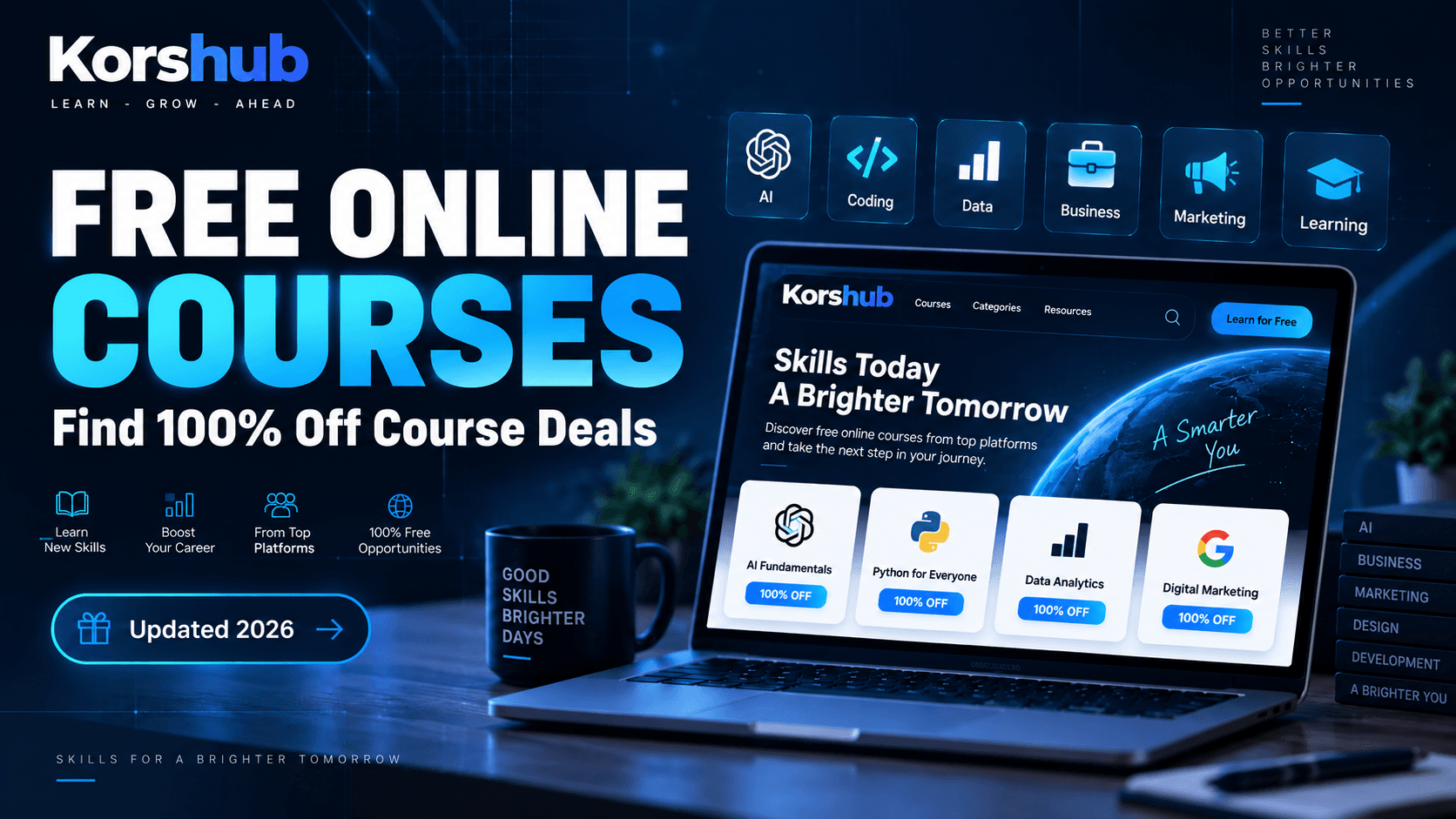
Instead of checking each website individually, we can use Korshub's free online courses page to browse current free courses and 100%-off course coupons from multiple learning platforms in one place.
Korshub currently aggregates free-course opportunities across multiple platforms and allows learners to filter courses according to factors such as category, platform, difficulty level, and language.
That matters because the goal should not be to find more courses.
It should be to find the right course faster.
What Does “Free Online Course” Actually Mean?
Not every free course works in exactly the same way.
Understanding the difference can help us avoid surprises.
1. Completely Free Courses
Some courses are created as free learning resources from the beginning.
There is no temporary discount required. As long as the provider continues offering the course for free, learners can access it according to that platform's terms.
These courses can be excellent for introductory learning, foundational skills, and exploring a new subject before committing to advanced training.
2. Paid Courses With 100% Off Coupons
This is where things become interesting.
An instructor may normally charge for a course but temporarily release a coupon that reduces the enrolment price to zero.
For the learner, it creates an opportunity to enrol without paying the normal course price.
Korshub's free-course section includes both genuinely free courses and courses carrying active 100%-off promotions. These coupons can be limited by time or redemption quantity, which is why a deal may disappear after it becomes popular.
This is also why we should check the final course page before assuming an older coupon is still active.
3. Free-to-Start Courses
Some learning platforms operate through subscriptions.
A course may allow us to view introductory material for free while requiring a membership to continue with the complete programme.
That does not necessarily make the course a bad option, but we should understand the access conditions before investing our time.
Best Free Online Courses to Learn Career-Relevant Skills
The best subject depends on what we are trying to achieve.
Someone trying to enter software development needs a very different learning path from someone trying to improve a small business's marketing.
Here are some of the most useful categories to consider.
Free AI and Machine Learning Courses
Artificial intelligence is one of the most rapidly evolving areas of professional learning.
Instead of trying to learn “AI” as one enormous subject, beginners can break it into smaller areas:
Artificial intelligence fundamentals
Python
Machine learning
Generative AI
Prompt engineering
Large language models
Retrieval-Augmented Generation (RAG)
AI agents
Data processing
MLOps
AI application development
One common mistake is starting with advanced tools before understanding the fundamentals.
If we have never written Python before, for example, jumping directly into complex machine-learning deployment may create more confusion than progress.
A better strategy is to choose a course appropriate to our current knowledge and move one step at a time.
Free Programming Courses
Programming is particularly suitable for online learning because we can practise almost everything while studying.
Popular subjects include:
Python
JavaScript
Java
C++
SQL
HTML and CSS
React
Node.js
Git and GitHub
APIs
Full-stack web development
Watching programming videos without writing code is similar to watching someone exercise and expecting ourselves to become fit.
We need to practise.
After every important concept, we should stop the lesson and build something ourselves.
Even a small project can make a difference.
A beginner learning Python could build a calculator, file organiser, simple automation script, or basic data-analysis project.
Free Digital Marketing Courses
Digital marketing is another subject where practical learning matters more than memorising definitions.
Useful course topics include:
Search engine optimisation
Social media marketing
Content marketing
Google Ads
Email marketing
Marketing analytics
Keyword research
Conversion optimisation
Copywriting
Ecommerce marketing
If we are learning SEO, for example, we should not stop after understanding what a keyword is.
We should choose a real topic, research search intent, structure a page, write the content, optimise internal links, and observe how search engines respond over time.
That experience teaches us more than simply completing another lesson.
Free Data Science and Analytics Courses
Data skills can be valuable far beyond traditional data-science jobs.
Marketers use analytics.
Operations teams use data.
Business owners use dashboards.
Financial professionals use spreadsheets.
Product teams study user behaviour.
Good subjects to explore include:
Excel
SQL
Python
Power BI
Tableau
Statistics
Data visualisation
Machine learning
Data cleaning
Business intelligence
We should start with the tool closest to the problem we want to solve.
Someone who needs to analyse business reports tomorrow may get more immediate value from Excel or Power BI than from an advanced machine-learning course.
Free Courses for Students
Students often face a specific problem: they need experience to get opportunities, but they need opportunities to gain experience.
Online learning can help break that cycle when we use it correctly.
A student can learn a skill and then turn it into a small portfolio project.
For example:
A computer science student could build a web application.
A marketing student could create an SEO case study.
A finance student could build an Excel or Power BI dashboard.
A business student could analyse a real company's marketing strategy.
A data-science student could work with a public dataset and publish the analysis.
The course provides the knowledge.
The project provides the evidence.
That distinction matters.
How to Choose a Free Online Course That Is Actually Worth Completing
A zero price does not mean zero cost.
Every course still costs us time.
Before enrolling, we should check several things.
Look at the Curriculum
Does the course teach something we actually want to know?
Course titles are designed to attract attention. The curriculum tells us what we are really going to learn.
Check the Difficulty Level
A beginner course may be frustratingly basic for an experienced learner.
An advanced course may be almost impossible for someone without the required foundation.
Choose the level that matches where we are now, not where we hope to be next year.
Check the Course's Relevance
Some subjects change much faster than others.
Basic mathematics may remain relevant for years.
A course about a rapidly changing AI tool, advertising dashboard, software library, or cloud platform may need much more recent material.
Look for Practical Learning
Projects, demonstrations, exercises, quizzes, examples, and assignments usually make a course more useful.
We should finish the course being able to do something—not simply being able to say we watched it.
How to Stop Collecting Free Courses and Start Completing Them
There is an unusual problem with free courses.
Because we do not pay for them, enrolling feels effortless.
We find a Python course and save it.
Then an AI course.
Then digital marketing.
Then Excel.
Then cybersecurity.
A month later, we have 30 courses and have completed none.
Instead of building the largest possible learning library, we can use a simple rule:
One main course. One current goal. One practical project.
If our goal is to learn Python, complete the Python course before starting five unrelated subjects.
When that course is finished, build something.
Then move forward.
The value of online education comes from skills we can use—not from the number of courses attached to our account.
Can Free Online Courses Help Us Get a Job?
They can help, but completing a course should be the beginning rather than the end.
Suppose two candidates apply for the same entry-level data role.
Candidate A writes:
“Completed a data analytics course.”
Candidate B writes:
“Completed a data analytics course and built an interactive dashboard analysing 50,000 rows of public data.”
The second candidate gives the employer something concrete to discuss.
After completing a course, we can create:
A GitHub project
A portfolio website
A dashboard
A case study
A marketing plan
A design project
A research project
A working application
A technical article
This turns learning into evidence.
Do Free Online Courses Include Certificates?
Sometimes.
But “free course” and “free certificate” are not the same thing.
A provider may offer free access to the lessons while charging separately for certification. Another may include a certificate. A temporary promotion may have completely different conditions.
We should check the official course page before enrolling if obtaining a certificate is important to us.
More importantly, we should not choose a weak course simply because it provides a certificate.
Skills first.
Certificate second.
How to Find Free Course Coupons Before They Expire
Free coupons are often temporary.
Some are available for a fixed period. Others have a limited number of redemptions. Once that limit is reached, the course may return to its regular price.
That means bookmarking an old list of coupons is not always useful.
We need current information.
Learners looking for available offers can browse free courses and 100% off coupons and then verify the final enrolment details on the original learning platform before completing enrolment. Korshub also highlights time-sensitive deals and directs learners to the official course platform rather than handling the enrolment itself.
If a coupon has expired, there is little value in repeatedly trying the same link.
Move to another current option.
A Better Way to Learn Online for Free
We can simplify the entire process into five steps.
Step 1: Choose the Problem
What do we want to accomplish?
Not “learn AI.”
Instead:
“I want to build a basic AI application.”
Not “learn marketing.”
Instead:
“I want to understand how to get organic traffic to a website.”
Specific goals make course selection easier.
Step 2: Find the Right Course
Search by subject and compare the curriculum, difficulty level, instructor, and practical content.
Step 3: Complete It
Avoid constantly switching courses.
Finish what is useful.
Skip sections we genuinely already understand.
Step 4: Build Something
Turn knowledge into a project.
Step 5: Repeat at the Next Level
Once we understand the fundamentals, choose the next skill gap.
This creates a learning path instead of an endless collection of courses.
Why Korshub Can Make Free Course Discovery Easier
A major frustration with online learning is fragmentation.
Courses are spread across different websites, discounts appear and disappear, and learners often spend more time searching for learning resources than actually learning.
Korshub is designed around that discovery problem.
The platform brings course deals from multiple learning platforms into one catalogue, while learners still enrol through the original course provider. Korshub also provides course browsing, filters, free-course discovery and deal-related tools designed to make comparison easier.
For us as learners, this changes the starting question.
Instead of asking:
“Which learning website should I search today?”
We can start with:
“What skill do I want to learn?”
That is a much better place to begin.
Frequently Asked Questions
Where can I find an online course for free?
We can find free courses directly through learning platforms, educational organisations, instructors, or course-discovery services. Korshub also maintains a dedicated page bringing together free courses and active 100%-off course offers from multiple platforms.
Are free online courses really free?
Some are permanently free, while others become free temporarily through 100%-off coupons. Subscription platforms may also provide limited free access. Always check the final course page before enrolling.
Do I need a credit card for a 100% off course?
For the free enrolments and 100%-off coupons listed as such on Korshub, the site states that no credit card is required for the free enrolment itself.
Which free course is best for beginners?
There is no single best course for everyone. The right choice depends on our goal. Beginners should usually prioritise introductory courses with clear explanations, practical exercises, and no unnecessary prerequisites.
Can I learn AI online for free?
Yes. Free courses are available across areas including Python, AI fundamentals, machine learning, generative AI, and related technologies. Beginners should start with fundamentals and gradually move toward specialised topics.
Can a free online course improve my career?
Yes, particularly when we apply what we learn. A completed project, portfolio example, case study, or working application can make the learning much more valuable professionally.
Why do free course coupons expire?
Course creators may restrict promotions by duration or redemption quantity. When that limit is reached, the free price can disappear even if an older promotional page remains online.
Start With One Course, Not Twenty
Finding an online course for free is easier than ever.
Finding one worth completing requires a little more thought.
We do not need hundreds of courses.
We need one course that solves the next learning problem in front of us.
Choose a subject. Check the curriculum. Make sure the offer is still available. Complete the useful lessons. Build something with the knowledge.
Then move to the next skill.
If we are ready to begin, we can explore free online courses available today on Korshub and choose a course based on the skill we actually want to develop.
Because the goal is not to collect free education.
The goal is to turn free access into useful knowledge—and useful knowledge into something we can actually do.