Google Ads Campaign Types in 2026: Search vs Performance Max vs Demand Gen
Subham Chand
Sep 29, 20266 min read41 views
You can launch a Google Ads campaign in minutes and spend for weeks without knowing what worked. The mistake often happens before the first ad goes live: choosing a campaign type because it sounds powerful, before deciding what a valuable customer action looks like or how to measure it.
This guide to Google Ads campaign types in 2026 helps you choose between Search, Shopping, Performance Max, Demand Gen, and other formats. If you want to see practical campaign setups afterward, the Google Ads MasterClass 2026 covering all campaign types covers these topics. The course is taught in Spanish, so check that the language works for you before enrolling.
Advertisement
Google Ads campaign types in 2026: start with customer intent
Before opening the campaign menu, finish this sentence: “I want someone to ___, and I will verify it through ___.” For an online store, that might be “buy a product” and “a recorded purchase value.” For a service business, it could be “request a quote” and “a qualified form submission,” rather than just a click.
Then ask when the need arises. If someone searches for “emergency plumber in Madrid,” a Search ad can meet existing demand. If you sell a product people do not yet know they need, strong images or video may help create interest.
Your situation | Campaign type to evaluate first | What you need ready |
|---|---|---|
People actively search for your service | Search | Keywords, ads, a relevant landing page, and conversion tracking |
You sell physical products from a catalog | Shopping or Performance Max | Merchant Center, accurate product data, and purchase values |
You want to expand conversions across channels | Performance Max | Reliable conversion goals and creative assets |
You want to build interest with images or video | Demand Gen | Creative assets, audiences, and a measurement plan |
You promote an app | App | App events and appropriate measurement |
This is a starting point, not a performance guarantee. Your margin, budget, and data quality still matter.
Search campaigns: when customers already know what they want
Search is a sensible first test when you can name the queries a customer would use before taking action. Group ads around specific offers and send each click to a page that answers that query. “Motorcycle insurance” and “car insurance” deserve different messages and landing pages.
Check the actual search terms triggering your ads. Add negative keywords when you see queries that do not fit your offer. That tells you whether you are buying useful opportunities or irrelevant visits.
The limitation is straightforward: Search can capture existing intent, but it cannot, by itself, create interest in a solution someone has never considered.
Search vs Performance Max vs Demand Gen: the quick decision
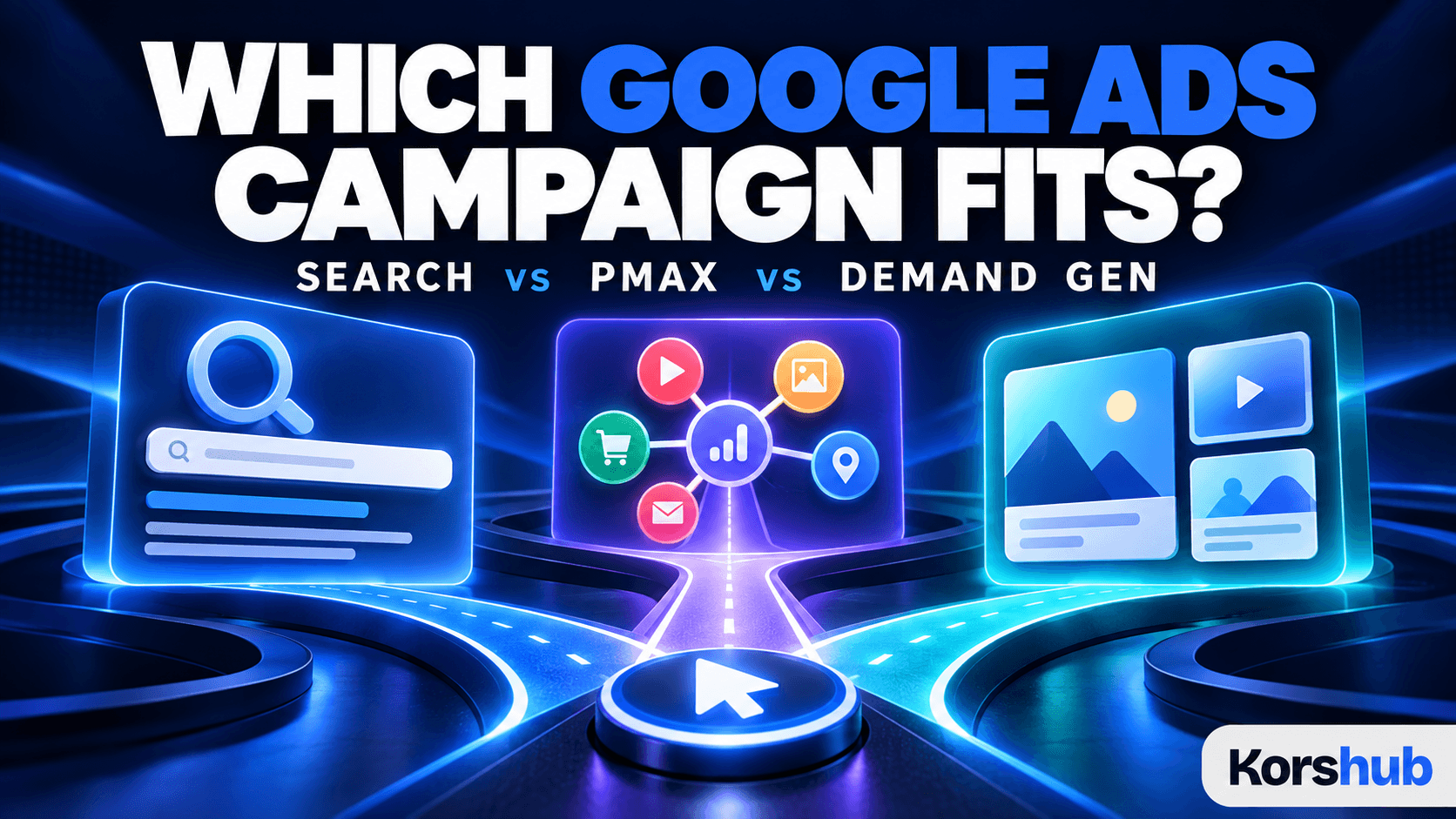
If people already search for what you sell, evaluate Search first. If you want to pursue conversions across Google’s channels and have trustworthy conversion data, evaluate Performance Max. If you need to build interest before the search and have strong visuals, test Demand Gen. There is no universal winner: each handles a different part of the buying journey.
Where Shopping, Performance Max, and Demand Gen differ
Shopping displays product information and works best with a well-maintained catalog. Titles, availability, prices, and product pages matter as much as campaign settings. A poor feed can look like a bidding problem when the underlying issue is missing product data.
Performance Max is a goal-based campaign that can serve across Google’s inventory. It needs useful conversion signals and adequate assets. “Automated” does not mean unattended: review your goals, products, creative, and available reports.
In a Performance Max vs Demand Gen comparison, ask what job each campaign should do. Demand Gen uses visual formats in discovery environments to reach people who may not be searching for your brand yet. Its creative and audience controls differ from those in Performance Max. You can test both if each has a defined role.
Display and Video are also campaign types with distinct uses. Google is moving certain Display campaigns into Demand Gen during 2026, so check the options currently available in your account before following an older setup tutorial.
Google Ads conversion tracking: set it up before you scale
Plenty of clicks can still be expensive when few turn into customers. Define the valuable action: a confirmed purchase, a qualified lead, or a useful phone call. Check that it records correctly, with the right value where applicable and without duplicates.
Suppose a service business optimizes for every visit to a “thank you” page. A test submission and a genuine prospect could count equally. If sales close over the phone, connect leads to their later quality when possible. Your campaign metric should reflect the business result as closely as you can manage.
Only then choose a bidding approach and a test budget. Compare cost per result with customer value or margin. Changing bids, audiences, ads, and pages every day makes it difficult to tell what improved performance.
Is this Spanish-language Google Ads course worth considering?
According to the creator’s description on Korshub, the course contains 110 video lessons, 23 assignments, 29 practice questions, and one exam. Its listed topics include Search, Display, Video, Shopping, Performance Max, Demand Gen, keyword research, conversion tracking, remarketing, reporting, Google Ads Editor, Asset Studio, and Gemini AI.
It may suit someone who wants practical setups collected in one learning path, whether for a store, their own business, or client accounts. The instruction is in Spanish, even though this guide is in English. You also do not need to master every campaign type before launching one: choose a goal, verify tracking, and practice the format that fits your case.
There is one useful currency check. The course outline lists enhanced CPC (eCPC), which Google discontinued for Search and Display in 2025. Check the lesson previews and current Google Ads interface to see which instructions still apply. Confirm the current price and terms on the course page before buying.
Frequently asked questions
Which Google Ads campaign should I start with on a small budget?
Start with the clearest business goal and a format you can measure. For a service with specific, active searches, Search may be a reasonable first test; avoid splitting a limited budget across too many campaigns at once.
What is the difference between Search and Performance Max?
Search focuses on ads associated with queries on Google’s search network. Performance Max uses automation across multiple Google channels to pursue conversion goals, making reliable tracking and regular review especially valuable.
Does Performance Max replace Shopping?
Not automatically. A retailer can evaluate both based on its goals, feed quality, and desired control. Compare sales and margin rather than clicks alone.
When should I use Demand Gen?
Consider it when you have strong visual assets and want to reach people in discovery settings before they make a direct search. Decide how you will assess its traffic and conversions instead of judging it solely as though it were a Search campaign.
Do I need conversion tracking before running ads?
Set it up if you want to learn which ads produce useful results. Test the conversion action before launch and confirm that its count and value match what your business calls success.