Other
 YouTube
Price
This course is free to watch on its platform.
Watch free on YouTube →Mark your own learning status. Opening a course link does not establish enrollment.
Loading saved status…
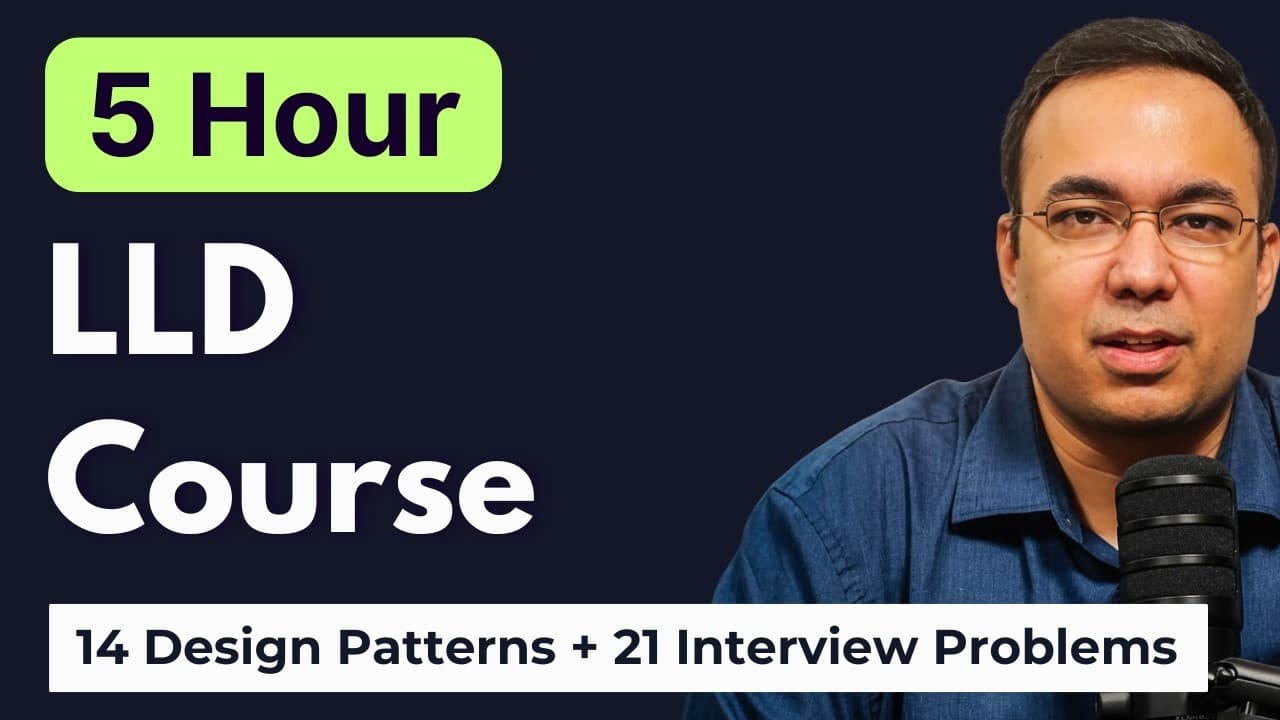
This course covers object-oriented design for interviews in a single long run. It moves from object-oriented principles to SOLID, then through the creational, structural and behavioural patterns, and finishes with pattern selection and anti-patterns.
Engineers who know the patterns by name but struggle to choose between them in an interview will find the pattern-selection section useful. Reference cards at the end of each part make the course a handy review tool after the first watch.
5-Hour Object-Oriented Design (LLD) Course: Complete Design Patterns for Interviews
===========
Timestamps:
===========
OOP PRINCIPLES (Interview Lens)
0:00:00 Welcome & Course Overview
0:02:56 OOP Principles Intro
0:05:17 Encapsulation & Invariant Protection
0:07:25 Encapsulation: UserProfile Example
0:12:08 Abstraction & Clean Contracts
0:14:29 Abstraction Leaks (How to Detect)
0:17:01 Abstraction: Payment Processing
0:19:05 Interview Practice: Notification Prefs
0:21:30 Inheritance & Is-A Relationship
0:24:55 Fragile Base Class Problem
0:27:53 Polymorphism & Extensible Behavior
0:30:59 Polymorphism: Notification Dispatch
0:35:16 Interview Practice: Document Export
0:37:20 Composition vs Inheritance Trade-Off
0:40:43 Class Explosion Problem
0:44:48 Interface vs Abstract Class
0:49:36 Decision Framework: 5 Design Checks
0:52:11 Interview Practice: Ride-Sharing System
0:54:57 Section Summary & Reference Card
SOLID PRINCIPLES
0:59:14 SOLID Principles Intro
1:01:54 SRP: Single Responsibility Principle
1:04:45 SRP: User Service Violation & Fix
1:09:19 SRP vs Microservice Boundaries
1:10:55 OCP: Open-Closed Principle
1:12:17 OCP: Discount Strategy Example
1:16:10 OCP: Recognition Signals
1:17:55 Interview Practice: Order Processor
1:20:14 LSP: Liskov Substitution Principle
1:22:31 LSP: Rectangle vs Square Problem
1:25:40 LSP: Read-Only Repository Example
1:29:50 Interview Practice: Archive Storage
1:31:54 ISP: Interface Segregation Principle
1:34:02 ISP: Machine Interface Example
1:37:18 DIP: Dependency Inversion Principle
1:41:54 DIP: Notification Service Example
1:48:16 Common SOLID Violations (Code Smells)
1:53:29 Section Summary & Reference Card
CREATIONAL DESIGN PATTERNS
1:58:01 Creational Patterns Intro
1:58:21 Factory Method Pattern
2:04:23 Factory: Notification Channel Example
2:08:22 Abstract Factory Pattern
2:15:15 Builder Pattern
2:20:03 Builder: User Profile Example
2:24:13 Interview Practice: HTTP Request Builder
2:26:16 Singleton Pattern
2:28:31 Singleton: When to Use vs Avoid
2:31:45 Singleton vs Dependency Injection
2:34:08 Creational Pattern Decision Tree
2:37:23 Interview Practice: Logging Framework
2:38:48 Common Mistakes & Reference Card
STRUCTURAL DESIGN PATTERNS
2:43:42 Structural Patterns Intro
2:45:59 Adapter Pattern
2:48:09 Adapter: Payment Gateway Example
2:53:17 Decorator Pattern
2:53:59 Decorator: Data Stream Example
3:00:42 Interview Practice: Metrics System
3:03:52 Facade Pattern
3:04:50 Facade: Order Fulfillment Example
3:10:45 When Facade Works vs Doesn't
3:11:52 Proxy Pattern (Caching, Lazy, Access)
3:14:16 Proxy: Product Catalog Example
3:19:42 Interview Practice: Facade & Proxy
3:24:43 Proxy vs Decorator Comparison
3:28:16 Common Mistakes & Reference Card
BEHAVIORAL DESIGN PATTERNS
3:31:44 Behavioral Patterns Intro
3:33:44 Strategy Pattern
3:35:25 Strategy: Pricing Engine Example
3:40:59 Strategy vs If-Else Comparison
3:43:15 Observer Pattern
3:44:24 Observer: Order Event System
3:50:10 Observer vs Message Broker Mapping
3:52:35 Interview Practice: Content Moderation
3:55:14 Command Pattern
3:56:46 Command: Text Editor Undo/Redo
4:00:34 Command: Task Queue Processing
4:02:57 State Pattern
4:05:27 State: Order Lifecycle Implementation
4:08:24 State vs Strategy Comparison
4:11:17 Interview Practice: Drawing App
4:13:28 Chain of Responsibility Pattern
4:15:23 Chain: Request Validation Pipeline
4:18:06 Template Method Pattern
4:20:53 Template: Data Import Pipeline
PATTERN SELECTION & ANTI-PATTERNS
4:23:16 Pattern Selection Intro
4:24:05 Signal-to-Pattern Recognition
4:26:19 Pattern Selection Framework (4 Steps)
4:29:33 Worked Example: Notification Service
4:32:16 Pattern Signal Reference Table
4:35:32 Multi-Pattern: Checkout Flow
4:39:52 Multi-Pattern: Messaging Platform
4:44:14 Multi-Pattern: File Storage System
4:49:04 Over-Engineering Anti-Pattern
4:51:17 MVD: Minimum Viable Design
4:54:41 Pattern Priority by Interview Tier
4:57:33 Patterns by Company Type
4:59:44 Circular Dependencies (Detection & Fix)
5:02:08 Premature Abstraction Anti-Pattern
=========
About me:
=========
I'm Mukul Raina, a Senior Software Engineer and Tech Lead at Microsoft, with a Master's from the University of Oxford, UK. On this channel, I create technical deep dives on System Design, LeetCode, DSA and ML/AI architectures.
#ObjectOrientedDesign #DesignPatterns #OOP #SOLIDPrinciples #SoftwareEngineering #SoftwareDesign #SystemDesign #FAANG #TechInterview #CodingInterview #InterviewPreparation #SeniorEngineer #DesignPatternsCourse #StrategyPattern #LLD #LowLevelDesign
Advertisement
No Korshub reviews yet.
Novice To Ninja: System Design (High Level Design)