Other
Free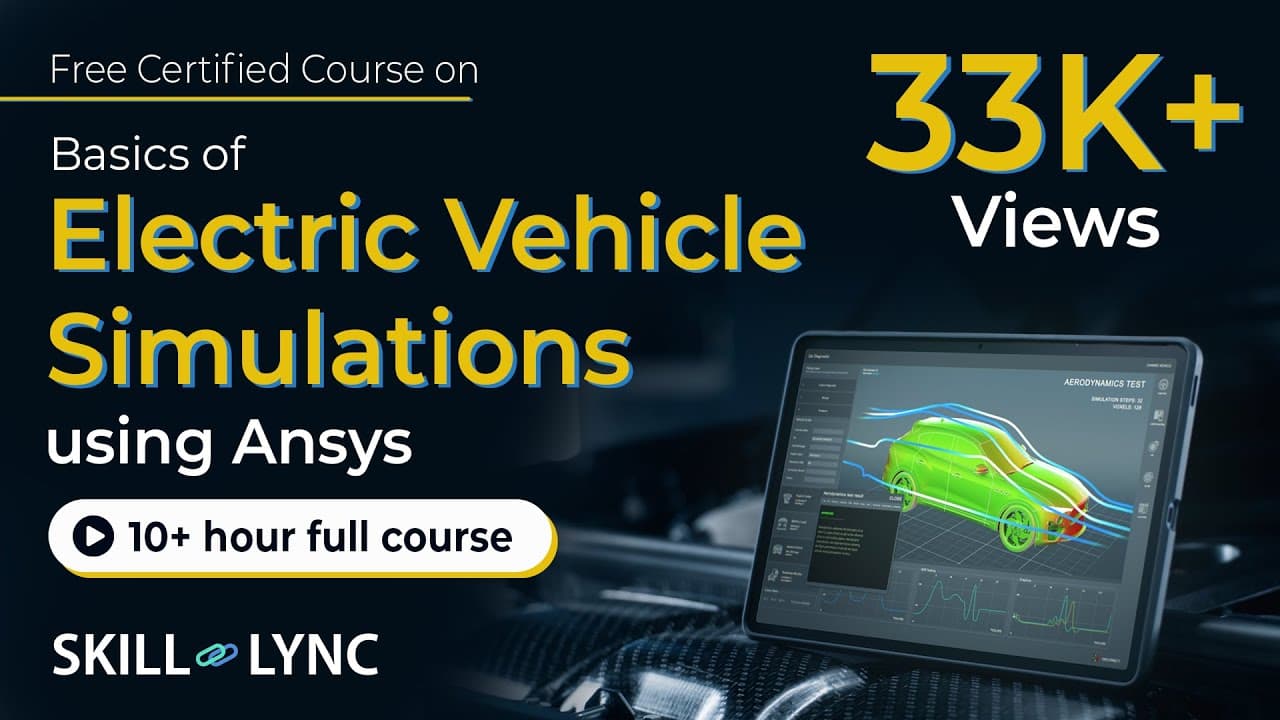 YouTube
Mark your own learning status. Opening a course link does not establish enrollment.
Loading saved status…
The course opens with EV fundamentals and a comparison between electric and combustion vehicles, then moves into battery voltage and chemistry, heat transfer modeling and a simplified battery thermal management system simulated in Fluent.
Later sessions cover vehicle aerodynamics, including force equations and simulating flow over a cylinder. The course uses several Ansys tools, including Fluent, RMxprt, Maxwell and Icepak, so it suits engineers who want a broad survey rather than a deep study of one tool.
Claim your certificate here - https://bit.ly/3ZQMhBl
If you’re interested in speaking with our experts and scheduling a personalized career plan, call us at +91-9342691281 or register here: - https://bit.ly/4h32ZUe
Welcome to Skill-Lync’s 10+ Hour Basics of Electric Vehicle Simulations using Ansys course! This comprehensive, free course is perfect for engineers and students looking to master the key concepts of electric vehicle simulations and understand their real-world applications.
In this Skill-Lync Electric Vehicle course, you’ll begin by exploring the fundamentals of electric vehicles, their increasing popularity, and why simulations are essential in designing and optimizing EV components. From there, you’ll dive into comparing EVs with Internal Combustion Engine (ICE) vehicles and understand the key components that make EVs unique.
Throughout this Skill-Lync Ansys course, you’ll explore the key components of EV architecture, gain insights into battery performance, and learn how to model heat transfer in batteries. The course also covers the Battery Thermal Management System (BTMS) using ANSYS Fluent, providing you with hands-on experience in setting up and simulating thermal conditions.
As part of the course, you’ll learn about motor power estimation, motor drive analysis, and the principles of motor sizing for electric vehicles. You’ll also perform aerodynamic simulations to understand how external forces affect vehicle efficiency. The final chapters dive deep into DC-DC converters and EV power systems, providing a complete overview of electric vehicle propulsion systems.
By the end of this Skill-Lync Ansys training, you will have a strong understanding of EV simulations using Ansys tools, making this course perfect for anyone interested in electric vehicle technology.
🔑 Key Topics Covered:
- EV fundamentals and global shift toward electric vehicles
- Battery performance and heat transfer modeling
- Battery Thermal Management System (BTMS) using ANSYS Fluent
- Motor power estimation and motor sizing
- External aerodynamics for EVs using Ansys tools
- DC-DC converters and EV power systems
📜 Course Highlights:
- Full 10+ hours of in-depth electric vehicle simulations training
- Free access with certificate upon completion
- Hands-on experience with ANSYS Fluent, RMxprt, Maxwell (2D), and Icepak
- Perfect for both beginners and professionals seeking to expand their knowledge of electric vehicle technology
Watch this free course on Skill-Lync’s YouTube channel and start gaining the skills needed to excel in the growing field of electric vehicle engineering! 📈
Timestamps -
0:04:30 - Basics of Electric Vehicle Simulation - Part One
0:13:29 - Electric Vehicles: Efficiency and Emissions
0:29:37 - Vehicle Architecture and Key Components of Electric Vehicles
0:30:36 - Understanding Vehicle Architecture: ICE vs Electric vs Hybrid
0:52:28 - Understanding Battery Voltage and Chemistry
1:12:19 - Heat Transfer Modeling for Batteries
1:37:48 - One-Dimensional Heat Conduction with Volumetric Heat Generation
1:54:29 - Fundamentals of Computational Fluid Dynamics
2:24:08 - Simulation of a Simplified Battery Thermal Management System
2:53:35 - Basics of Electric Vehicle Simulations Using Ansys: Motor Sizing and Drive Analysis
3:13:10 - Introduction to Electric Car Traction Motors
3:36:07 - Basics of Electric Vehicle Simulations Using Ansys: EV Motor Sizing and Motor Drive Analysis
3:58:13 - Vehicle Power Requirements Analysis
4:27:54 - Motor Sizing Short Course - Part 3
4:54:50 - Overview of Rotor Topologies and Magnet Configurations in Motors
5:11:17 - Introduction to ANSYS Electronics Desktop and RMxprt
5:30:59 - Introduction to Outer Rotor Motor and Analysis Setup
5:51:54 - Visualizing and Animating Magnetic Fields in Motor Analysis
6:08:48 - Basics of Electric Vehicle Simulation using ANSYS
6:46:02 - Efficiency of High Voltage vs Low Voltage Battery Systems in Electric Vehicles
7:08:50 - DCDC Converter Application Short Course: Part 2
7:41:23 - Full Bridge DC-DC Converter
8:07:38 - Full Bridge DCDC Converter Design and Implementation
8:42:15 - Basics of Electric Vehicle Simulation Part Four
8:51:57 - Fundamental Concepts of Fluid Mechanics
9:10:00 - Fundamentals of Trigonometry, Vectors, and Coordinate Transformation
9:31:55 - Practical Example of a Coordinate Transformation
9:35:17 - Deriving Equations to Compute Aerodynamic Forces
10:06:36 - Flow Regimes in Aerodynamics
10:12:41 - Why Care About Aerodynamics?
10:18:43 - Simulating Flow Over a Cylinder
👉 Subscribe to Skill-Lync for more free tutorials and courses.
#ElectricVehicle #SkillLync #SkillLyncTraining #EVSimulations #ANSYSFluent #EVBatteryThermalManagement #ElectricVehicleDesign #BatterySimulations #EVArchitecture #EVPowerSystems #DCConverters #BestEVSimulationsCourse #SkillLyncAnsysTraining #BatteryCoolingSystem #EVEngineering
Advertisement
No Korshub reviews yet.