Udemy
Free
Price
No active coupon right now
View Course →No coupon right now. We'll tell you when there is one.
Mark your own learning status. Opening a course link does not establish enrollment.
Learning music theory before playing is like learning grammar before speaking. This course uses the "sound before sign" method: you play real songs first (Imagine, Canon, Billie Jean, Happy Birthday) while picking up the fundamentals along the way. By the time you encounter note names and octaves, they're connected to music you've already made—not abstract symbols.
The instructor's a decade-deep teacher who's created thousands of practice videos. Every lesson is paced for engagement: fast enough to avoid boredom, slow enough to follow. An unexpected payoff is that building good technique from day one means you skip the painful unlearning phase most pianists endure. You learn to play well and play things you actually want to hear.
"Ok – so who would like to start playing the piano without the hours of frustration learning music theory? I’m one. That’s exactly what Benedict does in this course. … I’m amazed at what I’ve been able to learn and play." - Greg R
"This course walks you through playing simple songs, but they actually sound like the real thing which gave me a sense of accomplishment and encouraged me to keep playing. I highly recommend this course!" - Helenmary Cody
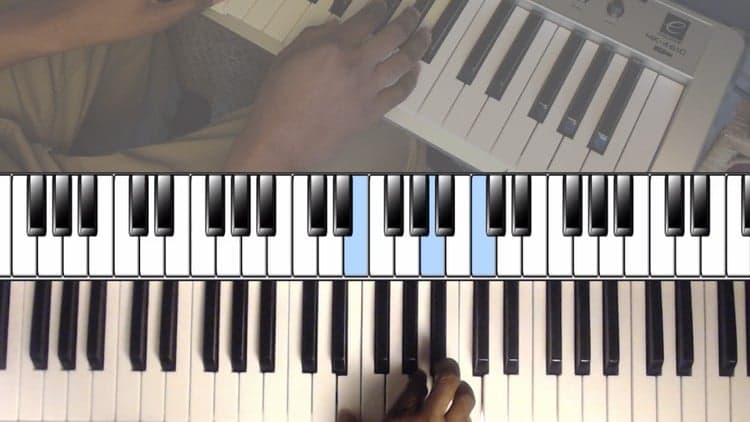
This course will teach you good piano technique by getting you to play real pieces of music. In it, I'll show you how to play the following pieces:
the riff to John Lennon's "Imagine" - When the Saints - Happy Birthday hands together - Amazing Grace hands together - the opening of Pachelbel's "Canon" - the bass line and chords of Michael Jackson's "Billie Jean"
And at the same time I'll teach you the following fundamentals:
which way is up on a piano - good practice technique - the finger numbers - playing in time - the note names - good hand position - how to play "legato" (and what that means) - phrasing - what an "octave" is - coordinating your 2 hands - how to play with a metronome - the right way to play chords
So why this beginner piano course instead of any other one?
1) It doesn't teach you how to play the piano by teaching you how to read music first
Almost all beginner piano courses teach you how to read music first and then get you to play from a score, but that's backwards - after all, you didn't learn to read before you could speak! Reading music is difficult, and if you try to learn how to play piano while learning how to read music at the same time you'll end up doing both badly. Instead, there's a body of research that shows that getting people to play first and then showing them how to read music is better (the approach is called "Sound before Sign"). This is the approach I use in this course. (I have a separate course which teaches you how to read music, called "Read Music FAST!", which you should do after this one.)
2) I have a ridiculous amount of experience teaching music using videos
I've been teaching piano one-on-one for over 10 years, to children and adult beginners as well as industry professionals, and I record practice videos for all of my students. At the time of writing I have over 4,000 private videos on YouTube, and so know exactly how to pace videos so that they're not so fast you can't follow them, but not so slow you get bored and stop either.
3) You'll develop good habits which will save you a ton of time in the future
A lot of beginner piano tutorials are designed to get you to play a piece as fast as possible, which is a good aim in itself (mine do the same), but they'll usually teach you bad habits at the same time, which you'll then have to spend a lot of time unlearning in the future. By contrast, I'll get you to play pieces as fast as possible but also make sure that you're developing good habits in the process so that there's no limit to how good you can get.
Advertisement
Not the best price we've seen. The lowest we've recorded is $12.99 on 17 Aug.
This is what we recorded in US pricing — not every price this course has ever had, and prices differ by country.