
Other
Free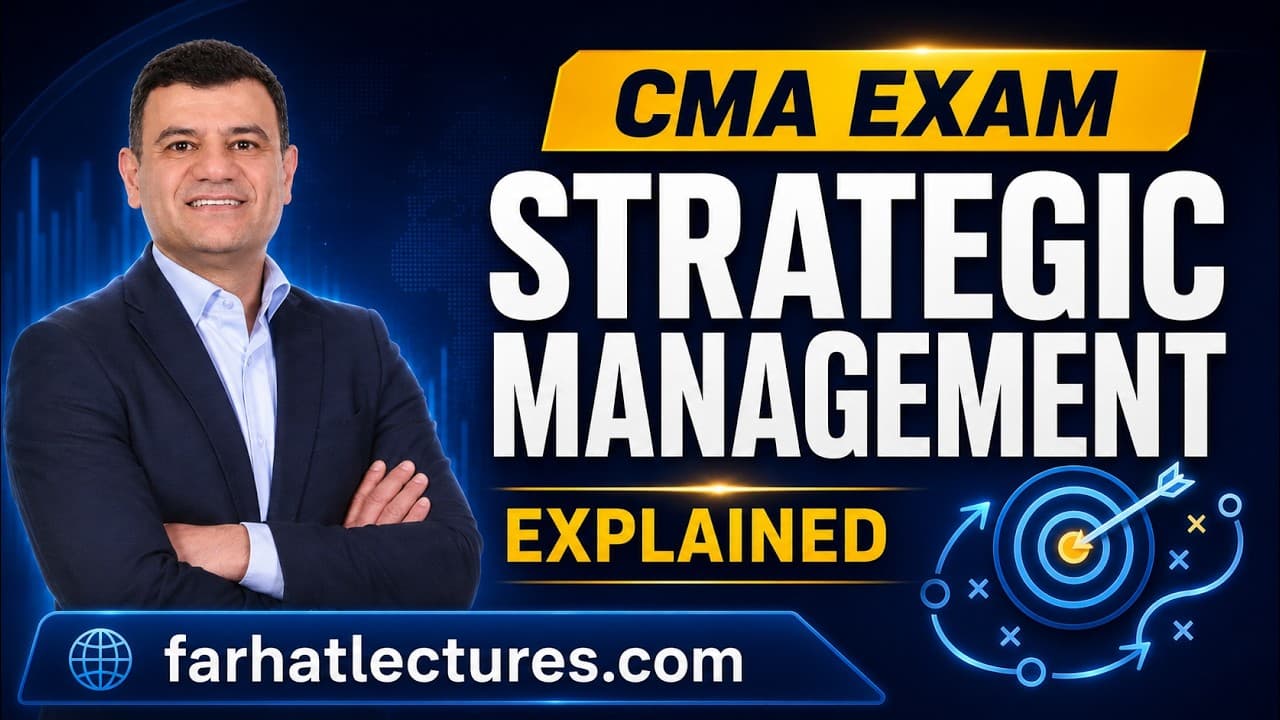 YouTube
Mark your own learning status. Opening a course link does not establish enrollment.
Loading saved status…
This playlist reviews chosen Part 1 topics across planning, performance and analytics, with the lessons arranged into study sections. It is best treated as a targeted refresher. The description is explicit that it does not cover the full exam outline, so you will still need the current content outline to fill the gaps.
Strategy, budgeting and forecasting form one chain: a plan becomes a budget, and the budget is tested against uncertainty through regression, learning curves and sensitivity analysis. Service-department cost allocation and integrated reporting then widen the view from internal numbers to how value is described over time.
The allocation lessons compare three ways of charging service departments. The direct method ignores support between service departments, the step method recognises one-way support, and the reciprocal method captures mutual services. Seeing them side by side makes the trade-offs clearer than studying any one alone.
For more resources, visit https://FarhatLectures.com
Review selected CMA Part 1 topics in financial planning, performance and analytics with Professor Farhat. This collection brings together 27 instructional lessons plus an optional Farhat Lectures study overview. It is also useful for managerial and cost accounting students studying strategy, budgets, forecasting and service-department cost allocation.
Follow the organized study sections:
1. Strategy and planning: strategic management, strategic planning and the Boston Consulting Group (BCG) portfolio matrix.
2. Budgeting: budget roles, participation and slack, budget types, zero-based and activity-based approaches, standard costs and master-budget schedules.
3. Forecasting and uncertainty: correlation, regression, learning curves, expected value and a worked example, followed by sensitivity analysis.
4. Cost allocation: introductory concepts, then direct, step and reciprocal service-department methods.
5. Integrated reporting: integrated thinking, six capitals, value creation and its process, guiding principles, content elements, and implementation benefits and challenges.
6. Optional final video: introduction to the Farhat Lectures study approach.
Does this playlist cover the entire CMA Part 1 syllabus? No. It is a selected-topic review. Use the current IMA content outline to identify additional study needed in financial reporting, performance management, internal controls, technology and analytics, and other exam topics.
How do the allocation methods differ? The direct method ignores service-department support to other service departments. The step method recognizes support in a one-way sequence. The reciprocal method recognizes mutual services through simultaneous relationships.
Does correlation prove causation? No. Correlation describes association. Regression estimates relationships under model assumptions, while sensitivity analysis explores how results change when assumptions change. Expected value is a probability-weighted average, not a guaranteed outcome.
What does integrated reporting explain? How an organization’s strategy, governance, performance and prospects relate to creating, preserving or eroding value over time. The Integrated Reporting Framework is maintained under the IFRS Foundation; it is distinct from IFRS Sustainability Disclosure Standards.
Choose a shorter topic playlist:
Budgeting and the master budget:
https://www.youtube.com/playlist?list=PLxP0KZzCGFYMJP6Kg5bZM6dgjmFlBqwcy
Cost allocation methods:
https://www.youtube.com/playlist?list=PLxP0KZzCGFYPWGTrHvAKjZsvi0UNfyUz2
Forecasting and strategy:
https://www.youtube.com/playlist?list=PLxP0KZzCGFYOmOjtzaO3jeJICUF3dwxRQ
Integrated reporting:
https://www.youtube.com/playlist?list=PLxP0KZzCGFYOR7-vGbJfujQK7VdWy6PB7
Advertisement
No Korshub reviews yet.