NPTEL
Free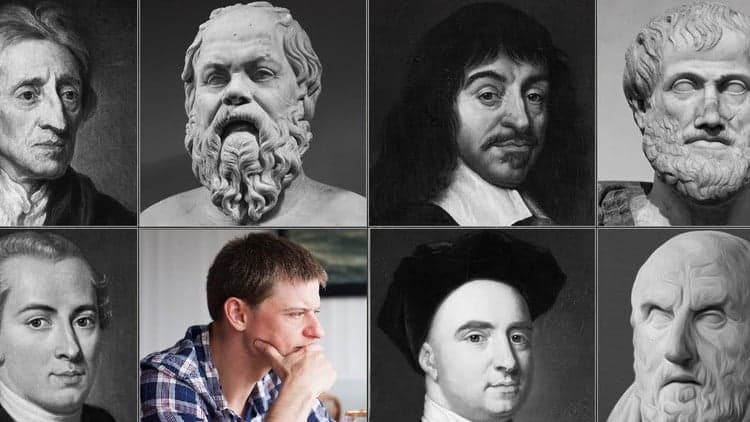 Udemy
Price
No active coupon right now
View Course →No coupon right now. We'll tell you when there is one.
Mark your own learning status. Opening a course link does not establish enrollment.
Loading saved status…
This lecture series moves through Western philosophy in order, from the pre-Socratics to twentieth-century thinkers. It follows how each school built on or reacted to the ones before it.
There are no quizzes or assignments, and 16 hours of lectures are available so far, with more to come. It suits self-directed listeners who want a long, sequential overview.
This series of lectures covers the main claims of western philosophers in chronological order, starting with the pre-Socratics and ending with twentieth century philosophers. More and more lessons will be added in the future; I am a passionate student of philosophy who enjoys discussing and sharing these ideas with others. There are no quizzes or assignments on this course, but there are 16 hours of lectures (so far).
Even though only a few fragments have survived from the writings of the pre-Socratics, we can still trace a logical development in their thought, which began with the worlds of being and becoming, and ended with the 'atoms and void' of Democritus, which is arguably the basis of modern chemistry. The stoics, the cynics, and the Epicureans flourished in Greece and Rome in a later period, developing ethical systems and building on the ideas of earlier thinkers. Plato wrote his 'Republic' at around this time, which has had a bigger impact than any other philosophical work, so we go through the ideas of this book in great detail. Aristotle was the student of Plato, but he developed a different metaphysical system. His system was greatly admired by Thomas Aquinas, who modified his ideas to support his own Christian beliefs. Two philosophers, Machiavelli and Hobbes, are perhaps the founders of modern political philosophy, so we examine their work next. The father of modern philosophy, Rene Descartes, developed a form of rationalism and had a tremendous influence on both mathematics and the scientific revolution. The rationalism of Descartes, Spinoza, and Plato argued that the chief source of all knowledge was to be found in deductive reason; in contrast, the British empiricists (Bacon, Locke, Berkeley, Hume) claimed that the only source of knowledge was obtained via the senses. While Bacon and Locke asserted that there must be a real world that causes our perceptions (realism), Berkeley contended that our perceptions are all we have (idealism). Kant created a new system, which he called 'transcendental idealism', in an attempt to deal with the arguments of the realists and idealists. Schopenhauer was a great admirer of Kant's ideas on time and space, but he suggested that Kant's famous 'thing-in-itself' was knowable in some sense, and he identified 'the will' as being the 'thing-in-itself'. Nietzsche took Schopenhauer's 'will' and turned it into the 'will to power', while Freud considered it a 'will to pleasure'. In the twentieth century, Heidegger arrived, ushering in a new age of existentialism.
Advertisement
Tracking since 15 Nov — not enough history yet to tell you whether today's price is any good. Watch the course and we'll tell you when it drops.
This is what we recorded in US pricing — not every price this course has ever had, and prices differ by country.
No Korshub reviews yet.