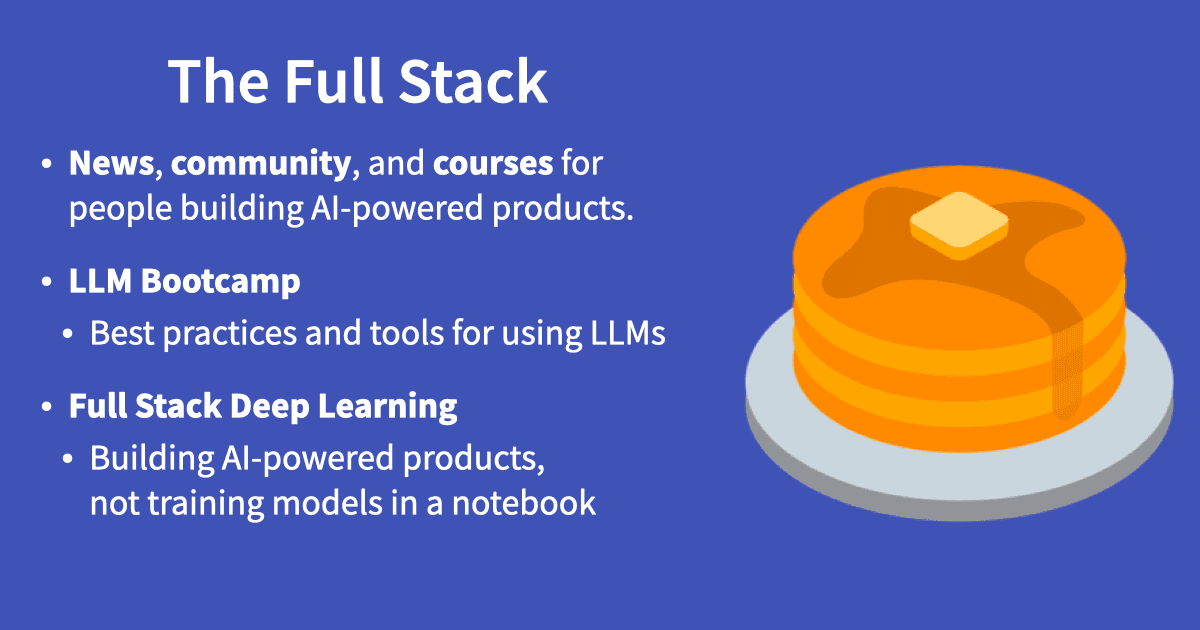
Full Stack Deep Learning course covers the full stack for building ML-powered products.
The Full Stack Deep Learning course started in 2018, as a three-day bootcamp hosted on Berkeley campus.
Since then, we've hosted several in-person bootcamps, online courses, and official university courses.
Explore the free 2022 lectures and labs. These materials reflect the tools and practices at the time of recording.
FSDL 2022 lectures and labs
- Lecture 1: Course Vision and When to Use ML: We review the purpose of the course and consider when it's a good (or bad!) idea to use ML.
- Lecture 2: Development Infrastructure & Tooling: We tour the landscape of infrastructure and tooling for developing deep learning models.
- Lab 4: Experiment Management: We run, track, and manage model development experiments with Weights & Biases.
- Lecture 3: Troubleshooting & Testing: We look at tools and practices for testing software in general and ML models in particular.
- Lab 5: Troubleshooting & Testing: We try out some Python testing tools and dissect a PyTorch trace to learn performance troubleshooting techniques.
- Lecture 4: Data Management: We look at sourcing, storing, exploring, processing, labeling, and versioning data for deep learning.
- Lab 6: Data Annotation: We spin up a data annotation server and learn just how messy data really is.
- Lecture 5: Deployment: We do a lightning tour of all the ways models are deployed and do a deep dive on running models as web services.
- Lab 7: Web Deployment: We create and deploy our ML-powered text recognition application with a simple web UI and a serverless model service.
- Lecture 6: Continual Learning: We consider what it takes to build a continual learning system around an ML-powered application.
- Lab 8: Model Monitoring: We add user feedback to our ML application and review data logged by actual users of the FSDL Text Recognizer.
- Lecture 7: Foundation Models: We look at how to build on GPT-3, CLIP, StableDiffusion, and other large models.
- Lecture 8: ML Teams and Project Management: We look at the structure of ML teams and projects, including how to hire or get hired on an ML team and how to build an ML-first organization.
- Lecture 9: Ethics: We consider ethical concerns around buiding technlogy, building with machine learning, and building artificial intelligence.