Udemy
Free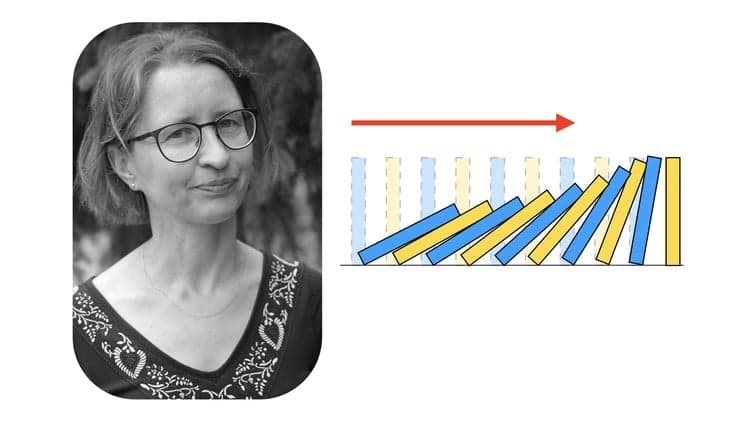 Udemy
UdemyMark your own learning status. Opening a course link does not establish enrollment.
Proving a statement is true for every natural number by checking n=0, n=1, n=2, and so on is obviously impossible — there are infinitely many of them. This short course introduces the standard solution: proof by induction, often illustrated with a domino-effect analogy, where showing the first domino falls and that each domino knocks over the next is enough to prove the whole line falls.
Who it's for: students encountering induction for the first time who want a focused, example-driven explanation. Note that questions aren't supported within this free course, though the instructor's related paid course on precalculus covers the same topic in more theoretical depth.
How would you prove that a theorem or a formula is true for *all* natural numbers? Try it for n=0, n=1, n=2, etc? It seems to be a lot of work, or even completely impossible, as there are infinitely many natural numbers!
Don't worry, there is a solution to this problem. This solution is called "proof by induction" and this is the subject of this short (and free) course. The Induction Principle is often compared to the "domino effect", which will be illustrated in the course. (This is also the reason for our course image.)
In this course you will learn how induction proofs work, when to apply them (and when not), and how to conduct them. You will get an illustration of this method on a variety of examples: some formulas, some inequalities, some statements about divisibility of natural numbers. You will also get some information about other courses where you can see some theory, and more advanced proofs based on the same principle.
Sadly, there is no possibility of asking question in free courses, but you can ask me questions about this subject via the QA function in my other course: "Precalculus 1: Basis notions", where the topic of proofs by induction is covered, both theoretically (Peano's axioms) and practically, with several examples.
Advertisement