YouTube
Free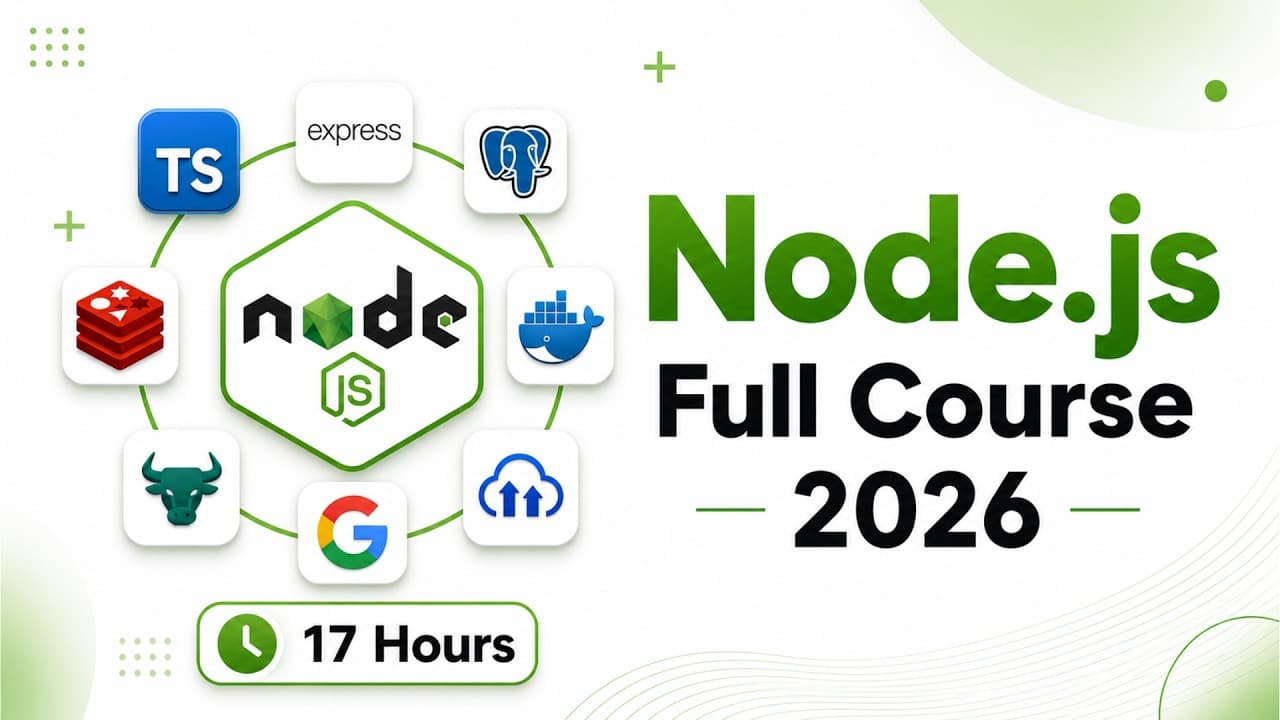 YouTube
Price
This course is free to watch on its platform.
Watch free on YouTube →Mark your own learning status. Opening a course link does not establish enrollment.
Loading saved status…
The opening stretch of this 17-hour course treats Node.js as a runtime worth understanding, not only a tool for installing packages. It covers the process object, timers, the file system, buffers, streams and the HTTP module before any framework appears.
Later parts introduce Express, PostgreSQL with raw SQL, and a Redis layer for caching, rate limiting and Pub/Sub. Uploads go through Cloudinary, background jobs run on BullMQ, and sign-in combines JWT with Google OAuth.
⭐▬▬ PART 2: NODE JS MICROSERVICES👋 ▬▬⭐
https://youtu.be/1341ei0Y8Rk
⭐▬▬ FOLLOW ACEDEVHUB LINKEDIN PAGE👋 ▬▬⭐
https://www.linkedin.com/company/acedevhub
⭐▬▬ JOIN ACEDEVHUB COURSE WAITLIST FOR FREE👋 ▬▬⭐
https://acedevhub.com/courses
⭐▬▬ DOWNLOAD SOURCE CODE FOR FREE👋 ▬▬⭐
https://acedevhub.com/projects/node-js-full-course-2026-complete-backend-development-course
In this 17-hour Node.js Full Course, you’ll learn Node.js fundamentals, internals, PostgreSQL, Express, Redis, Docker, JWT, Cloudinary, BullMQ, and Google OAuth while building a production-style backend project.
Key features:
🚀 17-hour complete course
🐘 PostgreSQL + SQL
🔴 Redis caching, rate limiting & Pub/Sub
🔐 JWT + Google OAuth
☁️ Cloudinary uploads
📬 BullMQ background jobs
⭐▬▬▬▬▬▬ TIMESTAMPS 👋 ▬▬▬▬▬▬⭐
0:00 - Introduction
5:06 - Node.js installation, npm, package.json, and scripts
35:25 - tsconfig.json file
40:02 - Process object
55:51 - Crypto module
1:11:53 - OS module
1:18:26 - Path module
1:31:23 - Timers module: setTimeout, setInterval, and setImmediate
1:49:14 - Callbacks
2:00:02 - Promises and async/await
2:09:21 - File system: synchronous APIs
2:26:22 - File system: callback APIs
2:33:18 - File system: Promise APIs
2:36:32 - Buffers
2:48:32 - Node.js URL module
2:56:39 - EventEmitter: listeners, on, emit, and once
3:07:49 - Streams
3:22:07 - Node.js HTTP module introduction
3:28:56 - Basic HTTP server
3:44:00 - HTTP routing concepts
3:52:57 - Reading the request body in plain Node.js
4:05:51 - Working with JSON response data
4:15:16 - Working with external APIs and AbortController
4:32:20 - Node.js runtime internals
4:44:22 - V8 engine
4:50:39 - libuv
4:58:25 - Blocking vs. non-blocking
5:02:35 - Cluster module
5:07:05 - PostgreSQL introduction
5:09:00 - PostgreSQL installation, setup, and database basics
5:24:40 - Creating a new database
5:33:50 - Creating a schema
5:40:34 - Creating a table
5:50:11 - SQL data types
5:59:00 - Other SQL data types
6:07:29 - NULL, empty string, and zero values
6:15:33 - Constraints
6:25:03 - Primary key concept
6:30:12 - SQL concepts base file
6:36:23 - Insert a single row
6:41:38 - Insert multiple rows
6:44:41 - Select specific columns
6:50:24 - WHERE basic filters
6:53:55 - AND, OR, and NOT filters
7:03:30 - LIKE pattern matching
7:09:31 - IN, NOT IN, and BETWEEN
7:16:15 - NULL and NOT NULL
7:20:08 - ORDER BY
7:22:29 - LIMIT, OFFSET, and pagination
7:29:11 - Update a single row
7:32:24 - Update multiple rows
7:36:15 - Delete rows
7:38:46 - RETURNING after INSERT, UPDATE, and DELETE
7:44:29 - Relationships and seeding tables/data
7:58:23 - Foreign keys
8:02:38 - One-to-many relationships
8:09:59 - INNER JOIN
8:15:05 - LEFT JOIN
8:21:03 - Many-to-many relationships
8:28:28 - Table aliases
8:34:06 - Aggregate functions
8:40:49 - GROUP BY and HAVING
8:48:07 - COUNT DISTINCT
8:53:41 - Subqueries
8:58:00 - Indexes: concept only
9:08:18 - Transactions
9:14:05 - Express setup, Pino logger, and folder structure
9:49:26 - CORS, Express routing, health route, and Express server setup
10:01:13 - Docker Compose setup, database migration creation, and SQL table schemas
10:16:59 - Database migration script implementation
10:39:53 - Error handler and registration/login flow overview
10:47:12 - User registration flow
11:14:56 - User login flow and JWT authentication
11:33:21 - Authentication and admin middleware, and fetching current user information
11:48:13 - User tasks CRUD implementation
12:30:12 - Admin: fetch all tasks, search, filter, and update task status
13:02:58 - Redis introduction
13:05:58 - Project overview
13:10:35 - Installing Redis, what Redis is, and why we need it
13:18:56 - Redis data types
13:19:31 - Strings
13:27:43 - Hashes
13:31:36 - Lists
13:35:28 - Sets
13:43:08 - TTL
13:47:31 - Connecting Redis to a Node.js project and setting up the Redis client
13:55:37 - Redis caching, cache-aside pattern, stale cache, and cache invalidation
14:03:08 - Redis caching example implementation
14:15:23 - Caching implementation in the Node.js project
14:42:53 - Implementing rate limiting with Redis
14:55:33 - Redis Pub/Sub concept and example implementation
15:07:37 - Redis Pub/Sub implementation in the Node.js project
15:21:24 - File upload flow, Cloudinary setup, Multer, and Redis Docker Compose setup
15:32:51 - Upload-to-Cloudinary helper implementation
15:41:29 - Multer middleware and banner create/fetch route implementation
16:00:21 - Banner Redis caching, cache-aside pattern, and cache invalidation
16:10:35 - Deleting Cloudinary images, BullMQ, background jobs, queues, and workers
16:31:19 - Google OAuth login implementation
▬▬▬▬▬▬ Subscribe for more! ▬▬▬▬▬▬
https://www.youtube.com/channel/UCuWZvXIeoDzZKCzpTuC5krQ
👋 ▬▬▬▬▬▬ CONNECT WITH ME ▬▬▬▬▬▬👋
Linkedin : https://www.linkedin.com/in/sangam-mukherjee-400488134/
Instagram: https://www.instagram.com/sangam_mukherjee/
#NodeJS #BackendDevelopment #ExpressJS #PostgreSQL #Redis
Advertisement
💥 Complete NestJS Backend Course (Beginner to Advanced) - Build RESTful APIs and a Full-Stack Social Media App
Next.js 16 Full Course | Build and Deploy a Production-Ready Full Stack App
Learn Python Backend Development by Building 3 Projects [Full Course]
Node JS Certification Course - Master the Fundamentals
No Korshub reviews yet.