Udemy
Price
No active coupon right now
View Course →No coupon right now. We'll tell you when there is one.
Mark your own learning status. Opening a course link does not establish enrollment.
Writing for orchestra begins with knowing the orchestra. This course divides the journey into two phases: first, learning how each instrument works—how it's built, what sound it makes, its range and playing techniques—then learning to combine them into cohesive scores.
You'll cover the mechanics of notation, the roles each section plays within the whole, and the practical work of preparing scores and parts for musicians. Reference charts help you navigate the thousands of small decisions orchestration demands. Throughout, you'll read actual scores and complete composing assignments to force the knowledge into your hands.
Designed for composers with music theory foundation who are ready to write for ensemble. The course acknowledges that true mastery requires years of score study beyond what any single course can deliver.
The course is divided into two parts: part 1 is on Instrumentation and part 2 is on Orchestration. Instrumentation is an important and necessary first step since you cannot write for orchestra if you don’t know about the individual instruments of the orchestra.
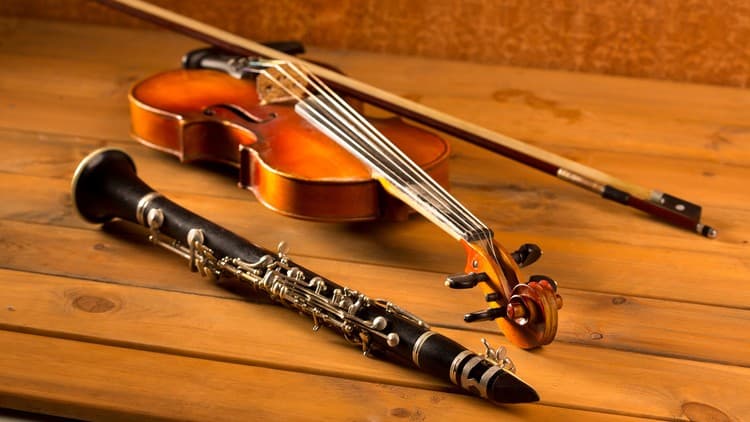
In part 1 you will learn how each instrument is constructed, how they produce sound, how they are properly notated, their playing and sounding ranges, register characteristics, dynamic capabilities and common playing techniques.
In part 2 you will learn basic concepts for writing for orchestra, including how to create and effectively use different timbres and textures, the best methods for scoring chords, the roles each instrument and section play within the whole, how to properly prepare a score and parts, and how to proof before publishing. The course concludes with an entire section of helpful orchestration tips and techniques. There are also a number of useful reference charts in the appendix.
At key points in the course you will be given score reading assignments, listening assignments, composing assignments, and quizzes.
A vital component to the study of orchestration is score reading, and so throughout the course you will be asked to read scores. There are some score excerpts in the course but the majority of score reading will be done on your own. There is an important reason for this. Taking a course in orchestration is a great start to learning how to write for orchestra but the only way to become truly knowledgeable and skilled in this very complex art form is through a lifetime of score study and through a lifetime of experience gained from actual writing for orchestra. This cannot be emphasized enough.
Note: This is not a music theory course or a music composition course. This course was written for individuals who already have a basic foundation in music theory (including music notation) and music composition. If you need or would like to develop your knowledge in these areas please see the following courses by the instructor.
Music Theory
Music Composition 1
Music Composition 2
Four-part Harmony
Advertisement

Write Your Symphony Now! | The Elements of Music Composition

Not the best price we've seen. The lowest we've recorded is $13.99 on 17 Aug.
This is what we recorded in US pricing — not every price this course has ever had, and prices differ by country.