
Other
Free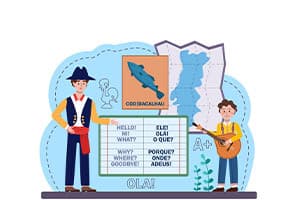 Other
Price
No active coupon right now
View Course →No coupon right now. We'll tell you when there is one.
Mark your own learning status. Opening a course link does not establish enrollment.
Loading saved status…
This course covers a lot of ground for a beginner: greetings suited to different times of day, numbers, colours, food vocabulary, the alphabet and pronunciation, animals, exercise terms, verb endings, the ser and estar distinction, and the days and months. It works as a survey, so expect each topic to be introduced briefly rather than drilled to fluency.
The verb section is the most structural part of the course. Learning how -ar, -er and -ir verbs conjugate, and where regular and irregular forms diverge, gives you a grammar base that supports every other topic. Pairing that with the ser and estar contrast, which trips up many learners, is a good use of the time.
Learning a new language is complex, requiring hard work, commitment and perseverance. However, learning a new language helps break social barriers, broaden your horizons and open professional doors. Portuguese is one of the Romance languages and if you combine the right strategies and resources with your steady motivation, learning the language will be a delightful experience. It is also noteworthy that Portuguese is the official language spoken in Brazil, with over 200 million native speakers, making it the second-most popular language in South America. It is also widely spoken in Portugal and some regions of Africa and Asia.
In this course, you will start by learning simple sentences for exchanging pleasantries and introducing yourself (known as 'cumprimentos') in Portuguese. You will explore the various forms of greetings, including the right words to say in the morning, afternoon and evening while addressing other people. Learn how to converse with your friends and express respect for the elderly. You will study the 'números' (the Portuguese system of numbering) and the 'cores', the general term used for different colours in Portuguese. In addition, you will discover the terms for Portuguese foods, including 'Os hidratos de carbono', 'A proteína', 'Os legumes', and 'As frutas', which represent the Portuguese terms for four classes of foods. Then you will learn how the English alphabet differs from the twenty-six letters of the Portuguese alphabet and how to pronounce the latter correctly.
Furthermore, you will encounter 'Os animais' and 'exercisio fisico', the general terms used for animals and physical exercises in Portuguese. Analyse verb conjugations, also known as 'conjugação dos verbos', and the rules that guide the conjugation of Portuguese verbs ending in '-ar', '-er' and '-ir'. Distinguish between the regular and irregular verbs and the difference between the 'Ser' and 'Estar'. Finally, consider the Portuguese concept of date and time, days of the week, from 'Segunda-feira' to 'Domingo' (Sunday to Monday) and the months of the year, from 'Janeiro' to 'Dezembro'. Mastering Portuguese will help you create lasting connections, enhance your travel experience and give you a competitive advantage in the job market. So, why wait? Start learning now!
Advertisement
No Korshub reviews yet.


Learn Portuguese: A 1-HOUR Beginner Conversation Course 🇵🇹