Agentic AI Jobs Are Up 986% — Here's How to Actually Learn It in 2026
Subham Chand
Sep 19, 20265 min read43 views
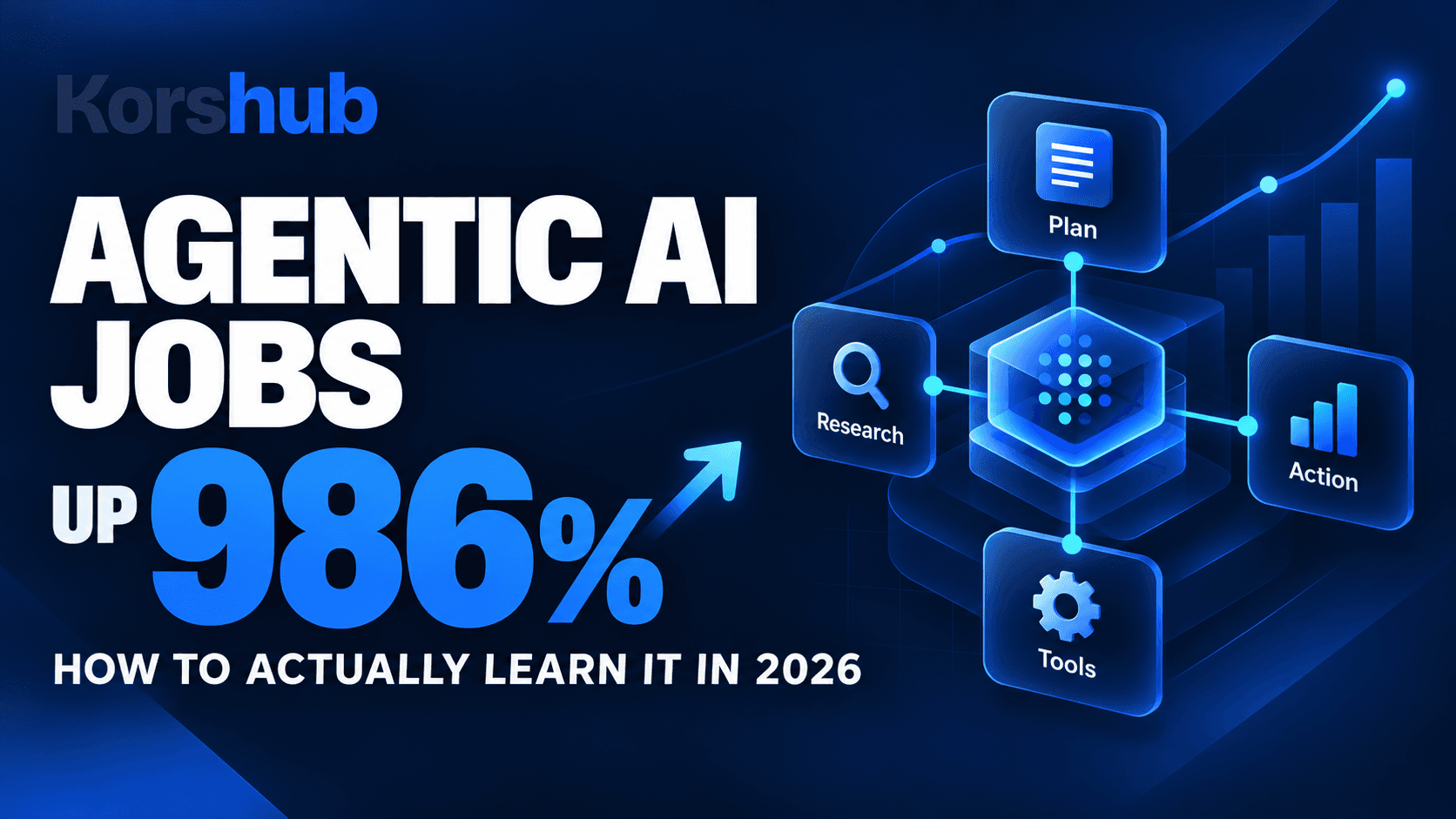
Job postings mentioning agentic AI skills grew 986% between 2023 and 2024, and the roles aren't slowing down — salaries for agentic AI engineers now range from $95,000 to well over $300,000 depending on seniority. That's the kind of stat that gets shared everywhere. What's missing from most of those posts is the actual "okay, so how do I learn this" part. That's what this one covers.
Advertisement
Why "Agentic AI" Is a Different Skill Than "Prompting ChatGPT"
Most people's AI experience stops at asking a chatbot a question and reading the answer. Agentic AI is a different discipline entirely: instead of one prompt → one response, you're building systems where an AI agent can plan a multi-step task, call tools or APIs, remember context across steps, and hand off work to other agents — all without a human clicking "next" at every stage.
That's why companies like Deloitte, Salesforce, and NVIDIA are actively hiring for it as its own specialization, not folding it into general "AI engineer" roles. The skill set is genuinely different: agent architecture, memory systems, orchestration, and something increasingly called "Agent Ops" — monitoring and auditing agents once they're live in production.
The Four Tools Everyone Keeps Mentioning — What Each Actually Does
If you've searched "how to learn agentic ai," you've hit the same four names repeatedly. Here's what actually separates them, since most articles list them without explaining the difference:
Tool | What it's actually for | Best for |
|---|---|---|
LangChain | Modular building blocks for LLM apps — chains, tools, memory | Connecting an LLM to APIs, documents, and tools |
LangGraph | Graph-based control flow for agents — explicit states and transitions | Complex, stateful workflows that need reliability, not just "one shot" answers |
CrewAI | Multi-agent collaboration — agents with defined roles working as a team | Systems where multiple specialized agents need to hand off tasks to each other |
n8n | Low-code automation — visual workflow builder | Wiring agents into business tools (Slack, email, CRMs) without writing glue code for every integration |
The mistake most beginners make is trying to learn all four in isolation from tutorials scattered across YouTube. In practice, they're used together: LangChain for the LLM connections, LangGraph for the workflow logic, CrewAI when you need multiple agents cooperating, and n8n to plug the whole thing into real business tools.
What You Actually Need to Know Before Starting
Every agentic AI job posting circles back to the same prerequisites:
Python — non-negotiable; every framework above is Python-first
LLM fundamentals — how prompting, context windows, and tool-calling actually work
RAG (Retrieval-Augmented Generation) — since most real agents need to pull in outside data, not just rely on the model's training
Vector databases — for agent memory that persists beyond a single conversation
API basics — agents are only useful once they can call something outside the LLM itself
If any of those are unfamiliar, that's normal — most learners come to agentic AI already knowing basic Python, then build the rest on top.
A Realistic Learning Path
Python + LLM basics — variables, functions, and how to call an LLM API
NLP and Transformers — enough to understand why LLMs behave the way they do
RAG + LangChain — building your first tool-using, document-aware agent
LangGraph — moving from a single agent to stateful, multi-step workflows
CrewAI — coordinating multiple agents with defined roles
n8n — connecting your agent system to real tools without custom integration code
Guardrails and safety — the part almost every free tutorial skips, and the exact gap "Agent Ops" roles now exist to fill
This is roughly the structure the Agentic AI Masters 2026: LangChain, LangGraph & CrewAI course follows — Python and NLP fundamentals, into LLMs and RAG with LangChain, then LangGraph for production-grade multi-agent workflows, CrewAI for collaborative agent teams, n8n for low-code automation, and a dedicated section on guardrails and safety mechanisms. At 37 sections and 60+ hours, it's built for people who want the full stack in one place rather than stitching together four separate tutorials.
Who This Path Actually Suits
Developers who already know Python and want to specialize before the field gets more crowded
ML/data engineers looking to move into a role commanding a 15–20% premium over standard ML engineering positions
Career switchers targeting roles like AI Automation Specialist or AI Integration Engineer, which prioritize hands-on framework experience over formal AI degrees
It's less suited to complete beginners with zero programming background — get comfortable with Python first, then come back to this stack.
FAQs
Do I need to learn LangChain, LangGraph, CrewAI, and n8n all separately? No — they're complementary, not competing. Most real agentic systems use LangChain for LLM connections, LangGraph for workflow control, CrewAI when multiple agents need to collaborate, and n8n to wire the result into business tools.
Is agentic AI harder to learn than regular prompt engineering? Yes, meaningfully — prompt engineering is about wording a single request well. Agentic AI involves state management, tool-calling, memory, and multi-step reasoning, closer to traditional software architecture than to prompting.
What's the difference between an AI Agent Architect and an Agentic AI Engineer? Architects design the overall system — how agents are structured, what memory and safety constraints they need. Engineers build and deploy it — writing the LangChain/LangGraph/CrewAI code and integrating it with real APIs and databases.
Can I get an agentic AI job without a computer science degree? Yes — most postings prioritize hands-on framework experience (LangChain, LangGraph, CrewAI) and a portfolio of built agents over formal credentials, though certifications from providers like IBM, Google, or Microsoft can help you stand out.
What should my first agentic AI project be? A single-purpose agent with one clear job — a research assistant that searches and summarizes, or a customer-support agent that answers from a document set. Multi-agent systems with CrewAI are a natural second project once the fundamentals click.