AI for Business Course vs Free Microsoft Learn: Which Should Leaders Pick in 2026?
Prabhat
Oct 26, 20267 min read17 views
Most business leaders don't need another explanation of what ChatGPT is. They need to know where AI is actually useful, which ideas are worth testing, and how much control a human should keep.
That distinction matters for anyone searching AI for business training. Current India keyword research shows noticeably stronger demand for “AI for business” than narrower terms such as “AI for business leaders,” “generative AI for business,” and “AI for business course.” The search intent is clear: people aren't only trying to understand AI—they're trying to work out how to apply it.
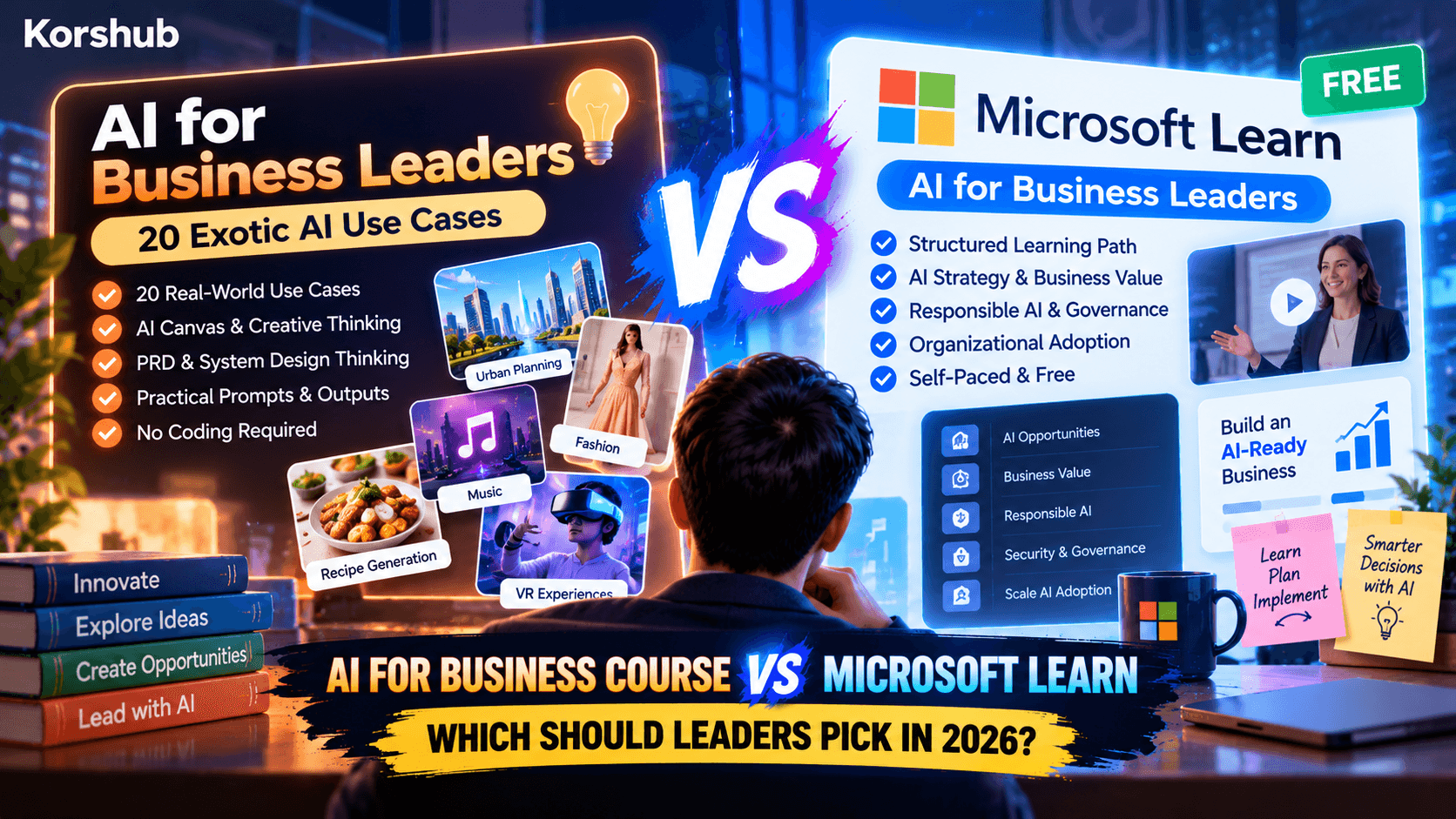
The AI for Business Leaders: 20 Exotic AI Use Cases course takes an unusual approach to that problem. Instead of another collection of email-writing and meeting-summary tutorials, it uses AI for urban planning, fashion, music, simulations, product concepts and other less obvious business scenarios.
Advertisement
But Microsoft also offers substantial AI leadership training through Microsoft Learn at no charge. So where should you start?
What This AI for Business Course Actually Teaches
The course is short by AI-training standards: 38 lectures across five sections, totaling about 3 hours and 17 minutes. It was updated in October 2026.
The curriculum revolves around four ways of thinking:
AI Canvas Thinking for structuring an AI idea
Creative Prototyping for rapidly exploring possibilities
PRD Thinking for defining product behavior and boundaries
System Design Thinking for seeing how different parts of an AI solution fit together
The 20 examples are deliberately unusual. You'll see generative urban design, fashion concepts, VR sensory environments, experimental music, recipe generation, alternative-history scenarios, museum guides, scientific hypothesis generation and AI-assisted cultural reconstruction.
That's the real selling point. The course isn't trying to teach executives how to code a model. It's trying to improve the way they frame AI opportunities.
Each module also includes PDFs containing prompts and real outputs, and the lessons show where decisions came from—the AI or the person using it. No programming background is required.
Who Is It Actually For?
The course makes the most sense for people who influence what gets built, not necessarily the people who will engineer it.
That includes executives, product managers, founders, innovation teams, consultants, UX designers and corporate learning professionals. The instructor also positions it as useful inspiration for data scientists and AI engineers looking for less obvious use cases.
At the time of checking, Korshub displayed a 4.9 rating from 7 ratings, 19 students and a $9.99 deal price reduced from $39.99. Coupons and course prices can change quickly, so check the current listing before enrolling.
AI for Business Course vs Free Microsoft Learn
Microsoft's current Transform your business with AI learning path is aimed at business leaders and owners rather than developers. It takes about 2 hours and 34 minutes and covers AI opportunities, business value, responsible AI and scaling adoption across an organization.
That makes the comparison more interesting than “paid course versus random free tutorials.”
Area | 20 Exotic AI Use Cases | Microsoft Learn |
|---|---|---|
Main focus | Generating and shaping unusual AI ideas | AI adoption and organizational strategy |
Coding required | No | No |
Learning style | Scenario-driven demonstrations | Structured learning modules |
Innovation frameworks | Strong focus | Some strategic frameworks |
Governance/responsible AI | Included through PRD thinking | Much stronger emphasis |
Real prompts and outputs | Yes | More conceptual/organizational |
Best for | Leaders who need fresh use-case ideas | Leaders planning AI adoption |
Cost | Check current Korshub deal | Self-directed learning available through Microsoft Learn |
Microsoft's material is particularly strong on something executives can't ignore: responsible adoption. Its learning path covers governance, security, assigning responsibilities and turning AI experiments into measurable business outcomes.
The Korshub-listed course is stronger when your problem happens earlier: We know we should explore AI, but we're struggling to imagine anything beyond chatbots and productivity assistants.
The Gap Most AI for Business Training Misses
There's a problem with AI use-case lists.
A clever use case isn't automatically a good business case.
An AI-generated fashion concept may be impressive. An AI research assistant may save time. A simulation may help a leadership team see a decision differently. But eventually somebody has to ask: What does this improve, what could go wrong, how will we measure it, and should AI be doing this at all?
That's where many AI courses become too enthusiastic.
The useful part of this course is that it doesn't only throw twenty ideas at you. Its PRD and system-design sections introduce boundaries and structure. Still, a three-hour course built around creative examples shouldn't be mistaken for a complete enterprise AI transformation program.
A sensible sequence is:
Use unusual examples to improve your ability to spot opportunities.
Select one process with a clear business problem.
Define the AI's inputs, outputs and authority.
Establish what a human must review.
Decide how success will actually be measured.
Only then test a pilot.
That's less exciting than saying “AI can transform everything.”
It's also considerably more useful.
What If You Want Practical AI Tools Instead?
This course is about thinking, not mastering every popular AI application.
If your goal is learning ChatGPT, Gemini, Midjourney and other tools for marketing, content and everyday business workflows, the Full AI Course 2026 on Korshub is a broader, tool-heavy alternative.
Another option is the Complete AI Guide covering ChatGPT, Claude and generative AI tools, which focuses much more on productivity, content creation, automation and practical software usage.
Those courses answer: “How do I use these tools?”
The 20-use-case course is closer to: “What else could we build or rethink with AI?”
Very different question.
Verdict: Which AI for Business Learning Path Should You Pick?
Choose the AI for Business Leaders course with 20 unusual AI use cases if you're a manager, founder, consultant or product professional who already understands the basic AI conversation but needs stronger ideas and frameworks for innovation.
It's especially useful if every internal AI discussion currently ends with the same three suggestions: automate emails, summarize documents and add a chatbot.
Start with Microsoft Learn if your bigger problem is AI strategy, governance, readiness and organizational adoption. Its current business-leader paths go deeper into responsible AI and scaling AI across an organization.
And there's nothing wrong with using both. Creative thinking helps you find better opportunities. Governance helps you avoid turning those opportunities into expensive mistakes.
FAQs
What is AI for business?
AI for business means applying artificial intelligence to business problems such as decision support, customer service, research, automation, product development and operational planning. The useful starting point is a defined business problem, not simply adopting an AI tool because it's popular.
What is the best AI course for business leaders?
The best course depends on the problem you're trying to solve. Use-case courses are helpful for innovation and ideation, while programs such as Microsoft Learn are more appropriate when you need strategy, governance and organizational AI adoption.
Do business leaders need coding skills to learn AI?
No. Leaders can learn to identify AI opportunities, evaluate risks, define requirements and measure results without writing code. Technical expertise becomes more important when systems must be integrated, developed or deployed.
How is generative AI used in business?
Generative AI can support research, writing, analysis, product ideation, customer interactions, simulations and decision preparation. The right use depends on data quality, risk, cost and how easily a human can verify the result.
Is AI for business training worth it?
It can be if the course helps you make better decisions about where AI belongs in your organization. A useful course should teach more than prompting—it should help you think about business value, limitations and human oversight.
What AI use case should a business test first?
Start with a repeatable, low-risk task where the output can be checked easily. Research summaries, internal drafting or idea generation usually make safer pilots than giving an AI system authority over payments, customers or other high-impact decisions.