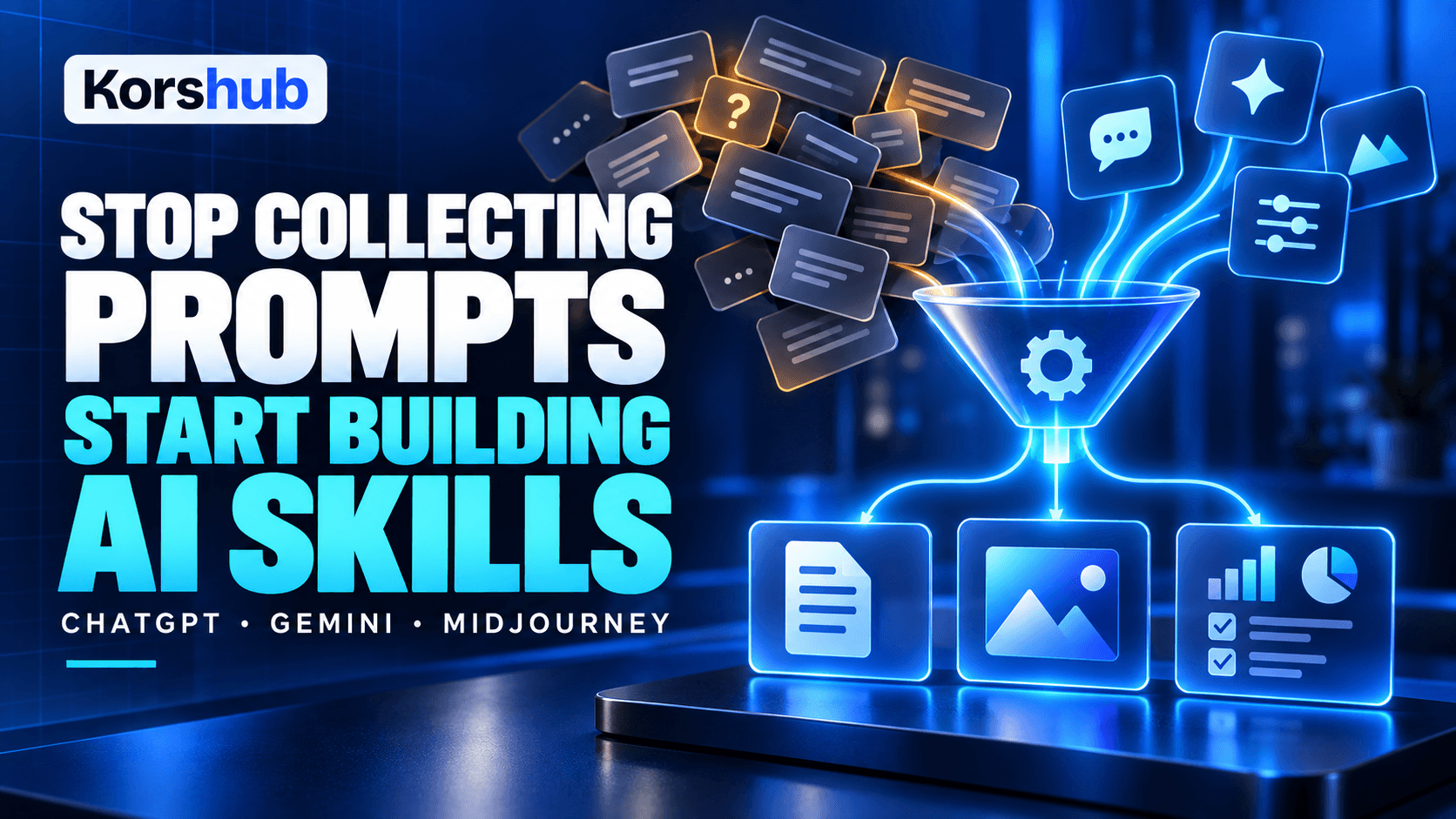
What a ChatGPT Course Should Teach in 2026
Knowing where the prompt box is doesn’t count as mastering ChatGPT. You need a repeatable process for explaining your goal, supplying context, controlling the format, and checking the answer.
A useful prompt normally contains:
The task you want completed
The audience or intended user
Relevant information and examples
The required format and length
Constraints the response must follow
Criteria for reviewing the final output
This structure works across ChatGPT, Gemini, and other generative AI tools. Interfaces will change, but clear instructions remain valuable.
The course covers prompt priming, modifiers, prompt revision, zero-shot, one-shot and few-shot prompting, comparative prompting, perspective prompting, reverse prompting, and other techniques. Use them to improve a real task rather than collecting prompt formulas you may never use.
Choose a Problem Before Choosing an AI Tool
Tool-hopping is one of the biggest problems for new AI learners. They try ChatGPT for five minutes, switch to Gemini, test an image generator, and finish with no reusable skill.
Begin with a problem instead:
Complete one useful output before adding another tool. You’ll learn faster because you can judge whether AI actually improved the work.
Start With One Complete ChatGPT Workflow
A single response isn’t a workflow. A workflow connects multiple steps and includes a quality check.
A content marketer, for example, could:
Define the target audience and its main problem.
Research questions that audience may ask.
Organize those questions into content topics.
Create an article or video outline.
Draft the first version.
Check every factual claim and rewrite weak sections.
Adapt the finished content for social media and email.
The course applies ChatGPT to blogs, social posts, advertising copy, SEO, YouTube scripts, podcast planning, email sequences, sales funnels, ecommerce descriptions, online courses, resumes, customer feedback, and office tasks.
It also includes case studies involving freelance services, course creation, video scripts, sales pages, content calendars, and an ebook publishing workflow. These examples are most useful when you rebuild one using your own topic or business.
Learn When to Use Gemini and Midjourney
ChatGPT and Gemini overlap in areas such as writing, research, planning, and analysis. Instead of asking which tool is universally better, test both with the same source material and instructions.
Compare:
How well each tool follows your format
Whether important details are missed
How much editing the response requires
Whether the answer can be verified
Which tool fits your existing workflow
Midjourney solves a different kind of problem. It focuses on creating and refining visual concepts through text and image prompts. The curriculum covers image generation, aspect ratios, style controls, negative prompts, image blending, consistency, product photography, website concepts, and business applications.
This is where a broad AI tools course can help: it shows that the best tool depends on the output you need.
Don’t Skip Verification
AI can produce an answer that sounds confident and still contains mistakes. It may invent details, overlook important context, misread data, or generate content that sounds almost identical to everything else online.
Before using an AI-generated result:
Verify names, dates, numbers, quotations, and factual claims.
Check whether important context is missing.
Remove repetitive and generic language.
Protect private company and customer information.
Review image outputs for accuracy and appropriate use.
Add your own experience, judgment, and examples.
Prompt engineering improves the input. Verification protects the final output. You need both.
What Does This ChatGPT and AI Course Cover?
The course listing describes 513 video lessons for learners at all levels. ChatGPT receives the largest share of the curriculum, beginning with fundamentals and moving into advanced prompting, writing, research, marketing, productivity, freelancing, business strategy, Custom GPTs, API concepts, data analysis, and coding assistance.
Additional sections cover Gemini, Google Workspace, Midjourney, Notion AI, Perplexity, NotebookLM, Vertex AI, Microsoft Copilot, Bing, marketing automation, customer service, product management, financial workflows, and AI for business.
At the time of review, the page displays a 4.8 rating from 398 reviews, approximately 15,000 students, and a price of $19.99. Prices, ratings, course content, and available coupons may change, so confirm the latest information before enrolling.
Some lessons reference particular model versions and interfaces. Because AI products change quickly, concentrate on the process being demonstrated rather than memorizing the location of every button.
Is This ChatGPT Course Right for You?
The course is best suited to marketers, creators, entrepreneurs, freelancers, and professionals who want to apply AI across several types of work. It may also suit learners who prefer having a large reference library instead of purchasing separate courses for each tool.
If you’re a complete beginner, don’t watch all 513 lessons in sequence. Start with ChatGPT fundamentals, prompt engineering, one section related to your work, and one finished project. Add Gemini, Midjourney, automation, or API lessons when your goals require them.
Learners primarily interested in machine learning mathematics, model training, or advanced AI engineering will need a more technical program. This curriculum focuses largely on using existing AI products for practical tasks.
You can examine the complete curriculum and current enrolment details for this ChatGPT and AI tools course before deciding whether its broad structure fits your learning goals.
Frequently Asked Questions
What is the best ChatGPT course for beginners?
The best ChatGPT course for beginners teaches prompt structure, practical workflows, responsible use, and output verification. It should help you complete real projects instead of providing only a list of prompts.
Can I learn ChatGPT without coding?
Yes. You can use ChatGPT for writing, research, analysis, marketing, productivity, and content planning without coding. Programming becomes useful when you want to build custom integrations or applications.
How long does it take to learn ChatGPT?
You can learn the basic interface and prompt structure in a few hours. Building reliable professional workflows usually takes several weeks of practice with real tasks and careful review.
Does this course include prompt engineering?
Yes. Its curriculum includes basic and advanced prompting techniques such as prompt priming, revision, modifiers, comparative prompts, and zero-shot, one-shot and few-shot prompting.
Does the course teach Gemini and Midjourney?
Yes. The listed curriculum includes Gemini for research, writing, marketing, and productivity, plus Midjourney for image prompting, consistency, visual concepts, and business applications.
Is a ChatGPT course worth taking in 2026?
A structured course can be useful if random tutorials leave gaps in your knowledge or you need guided practice. Choose one that emphasizes transferable workflows because AI interfaces and model names change frequently.