Digital Marketing Course: 10 Powerful Benefits That Can Transform Your Career in 2026
Prabhat
Aug 11, 20269 min read35 views
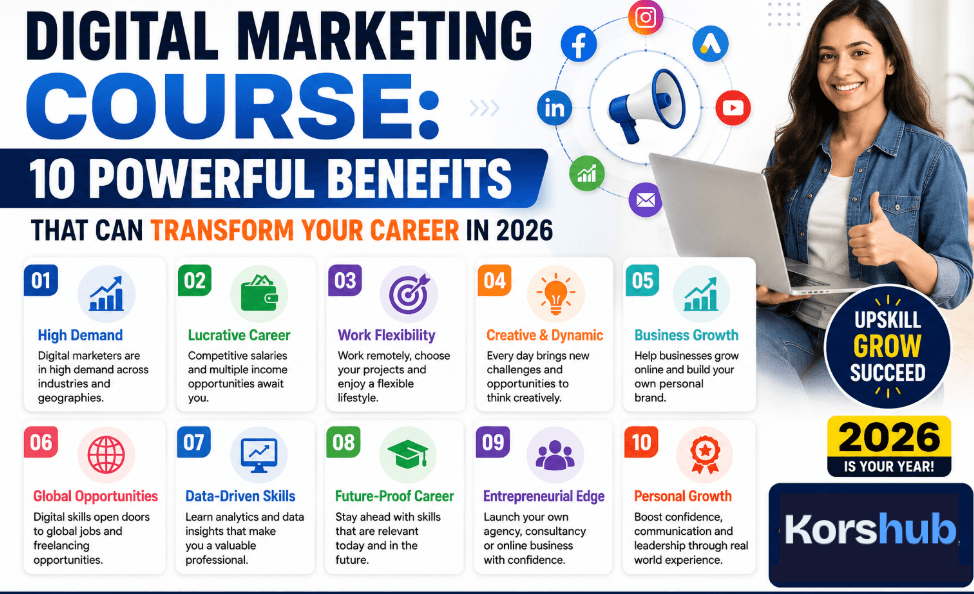
If you are thinking about changing careers, upgrading your professional skills, starting to freelance, or simply becoming more valuable in the modern workplace, a digital marketing course in 2026 can be a surprisingly powerful way to start. Digital marketing is no longer limited to posting on social media or writing blog articles. It now connects SEO, paid advertising, analytics, content strategy, email marketing, social media, conversion optimization, automation, artificial intelligence, and customer psychology into one rapidly evolving discipline. Businesses of almost every size need people who can turn online attention into measurable business results.
The timing is particularly interesting. The World Economic Forum's Future of Jobs Report 2025, based on input from more than 1,000 employers, found that nearly 40% of the skills required on the job are expected to change by 2030, while 63% of employers identify skills gaps as a major barrier to transformation. The report also expects AI, big data and other technology skills to grow rapidly, while creative thinking, analytical thinking, resilience and collaboration remain important. That combination tells us something important: the winning professional in 2026 will not simply know how to use a tool. They will know how to combine technology with human judgment to solve business problems.
What Is a Digital Marketing Course in 2026?
Advertisement
A modern digital marketing course teaches you how businesses attract, engage, convert, and retain customers through digital channels. The strongest courses go far beyond definitions and theory. They introduce practical areas such as search engine optimization, Google Ads, Meta Ads, social media marketing, content marketing, email campaigns, analytics, landing pages, conversion funnels, and marketing automation. Increasingly, they also include AI-assisted research, content creation, campaign analysis, and workflow automation because AI is changing how marketers perform everyday tasks.
Think of digital marketing as the engine behind an online business. A website may be the storefront, social media may be the conversation happening outside the store, search engines may be the road bringing customers toward it, paid advertising may be the signboard attracting attention, and analytics may be the dashboard telling you which parts of the engine are working. A course brings these pieces together so that you understand not only what each tool does, but also why and when to use it.
Why Learn Digital Marketing in 2026?
The digital economy is becoming increasingly intertwined with everyday commerce, entertainment, education and business. In India, for example, rapid internet adoption, digital payments and expanding online consumption are creating more opportunities for companies to acquire customers through digital channels. A recent FICCI-Deloitte report reported that India's private consumption could reach approximately $1.9 trillion by 2030, with internet accessibility, urbanization, rising incomes and digital infrastructure among the factors supporting consumption growth.
At the same time, digital marketing itself is changing. Search is becoming more conversational, advertising platforms are incorporating more automation, generative AI is accelerating content workflows, and businesses increasingly expect marketers to demonstrate measurable returns. This means learning digital marketing in 2026 is not about memorizing yesterday's tricks. It is about developing a foundation that allows you to adapt as platforms change.
Benefit #1: Build a High-Demand, Transferable Skill Set
One of the biggest benefits of taking a digital marketing course is that you do not learn a single narrow skill. You build a collection of complementary skills that can be applied in many different professional environments. SEO can help an e-commerce company generate organic traffic, but the same knowledge can help a freelancer grow a local restaurant website. Paid advertising can support a startup launching a product, while analytics can help an established company understand which campaigns are producing profitable customers.
A practical course can help you build that combination progressively. You can start with fundamentals such as SEO and content, move into paid campaigns and analytics, and then add automation and AI. Over time, your skill set becomes less like a single tool in a toolbox and more like an entire toolkit. That makes you more adaptable when employers change software, platforms alter their algorithms, or a new marketing channel becomes popular.
Benefit #2: Increase Your Job Opportunities
A digital marketing qualification can open doors to several different career paths rather than forcing you into one job title. Depending on your interests, you could work toward positions such as SEO Executive, SEO Specialist, Performance Marketer, PPC Specialist, Social Media Manager, Content Strategist, Email Marketing Specialist, Marketing Analyst, Growth Marketer, Digital Marketing Executive or Digital Marketing Manager.
The World Economic Forum's research reinforces the broader need for continuous upskilling. Its 2025 report estimates that 170 million new jobs could be created globally by 2030 while 92 million could be displaced, producing a net increase of 78 million jobs, while warning that skills gaps remain a major challenge.
Benefit #3: Learn AI-Powered Marketing Skills
AI is arguably the biggest reason a 2026 digital marketing course looks different from one created several years ago. AI can assist marketers with research, brainstorming, segmentation, copy variations, data interpretation, workflow automation, and many repetitive tasks. However, the arrival of AI does not eliminate the need for marketers; it changes the type of work that creates value.
Benefit #4: Master SEO and Organic Growth
Search engine optimization remains one of the most useful digital marketing disciplines because it focuses on attracting people who are actively looking for information, products or solutions. A good SEO curriculum should cover keyword research, search intent, on-page optimization, technical SEO, internal linking, content strategy, backlinks, structured data, website performance and measurement. In 2026, it should also discuss how search behavior is evolving as users increasingly interact with AI-powered search experiences.
Benefit #5: Understand Paid Advertising and Performance Marketing
If SEO is about earning visibility organically, paid advertising is about purchasing targeted visibility and measuring what happens next. A comprehensive course can introduce platforms such as Google Ads and Meta Ads, along with campaign structures, audience targeting, creative testing, landing pages, conversion tracking, bidding strategies, and performance analysis.
Benefit #6: Develop Analytics and Data-Driven Decision Making
Marketing without measurement is often little more than guesswork. One of the strongest benefits of a digital marketing course is learning how to turn campaign data into decisions. Depending on the curriculum, you may work with tools such as Google Analytics, Google Search Console, advertising dashboards, tag-management systems, spreadsheets, and visualization platforms.
Benefit #7: Create Freelancing and Remote Work Opportunities
Digital marketing has another advantage that traditional career paths do not always offer: many of its outputs can be delivered remotely. A marketer can conduct keyword research from a laptop, manage advertising campaigns online, create content calendars, analyze analytics, prepare reports, and communicate with clients without being physically present in the client's office.
Benefit #8: Start or Grow Your Own Business
You do not have to become a digital marketing employee to benefit from learning it. If you run a business—or plan to start one—marketing knowledge can save you from becoming completely dependent on agencies and freelancers for every decision.
Benefit #9: Build a Strong Personal Brand
Personal branding has become another practical application of digital marketing. Whether you are a consultant, creator, freelancer, teacher, entrepreneur, or job seeker, your online presence can influence how people perceive your expertise.
Benefit #10: Future-Proof Your Career Through Continuous Learning
No skill is completely future-proof, and anyone promising that a single course will guarantee lifelong career security is selling a fantasy. The better goal is to become adaptable. Digital marketing is useful in this regard because the field forces you to learn continuously. Search algorithms change, advertising platforms introduce new features, consumer behavior shifts, AI tools evolve, and new channels appear.
What Should a Digital Marketing Course Include?
Not every course deserves your time or money. Before enrolling, examine the curriculum carefully and look for a balance between fundamentals, practical assignments, current tools, and measurable outcomes. A modern program should ideally introduce SEO, content marketing, social media, paid advertising, analytics, email marketing, conversion optimization, and AI-assisted marketing workflows.
The best learning environment is one where you repeatedly move through the cycle of learn → implement → measure → improve.
Practical Outcome
How to Choose the Best Digital Marketing Course in 2026
Choosing a course should be treated like choosing a vehicle for a long journey. A flashy interface and hundreds of lessons might look impressive, but what matters is whether the course actually takes you where you want to go. Start by identifying your objective. Are you trying to get a job, become a freelancer, grow a business, specialize in SEO, master paid advertising, or understand marketing broadly?
Next, inspect the curriculum. Look for current topics rather than outdated tactics. A 2026 course should acknowledge AI, automation, privacy changes, modern analytics, evolving search behavior, and performance measurement. Also check whether the instructor demonstrates real-world implementation rather than simply reading slides.
How to Turn a Course Into a Career
Completing a digital marketing course is the starting line, not the finish line. Your next objective should be to convert knowledge into evidence. Create two or three meaningful projects that demonstrate your skills. You might conduct an SEO audit for a website, develop a 30-day content strategy, create a mock Google Ads campaign, analyze a conversion funnel, or build a complete digital marketing plan for a fictional brand.
Common Mistakes Beginners Make
One of the biggest mistakes is collecting certificates instead of building skills. Certificates can support your résumé, but they cannot substitute for practical competence. Another mistake is trying to master every marketing channel simultaneously. You end up knowing a little about everything without becoming genuinely useful at anything.
Conclusion
A digital marketing course in 2026 can transform your career because digital marketing itself sits at the intersection of technology, creativity, data and business. It can help you develop practical skills in SEO, paid advertising, social media, content, analytics, email marketing, AI and automation while giving you the flexibility to pursue employment, freelancing, entrepreneurship or personal branding.
FAQs
1. Is digital marketing a good career in 2026?
Yes, digital marketing can be a strong career option in 2026, particularly for people who combine marketing fundamentals with analytics, AI literacy and practical experience. However, the field is competitive, so completing a course alone is not enough. Building a portfolio and demonstrating measurable skills can make a significant difference.
2. Can I learn digital marketing without a degree?
Yes. Many digital marketing skills can be learned without a traditional marketing degree. What matters increasingly is whether you understand the fundamentals and can demonstrate practical ability through projects, campaigns, case studies, or relevant work experience.
3. Which digital marketing skill should I learn first?
For most beginners, a combination of SEO, content marketing, analytics and paid advertising fundamentals provides a strong foundation. After understanding the basics, choose one specialization based on your interests and career goals rather than trying to master every platform simultaneously.