Free MLOps Course vs Paid Options: Which Machine Learning Path Should You Pick in 2026?
Prabhat
Sep 22, 20266 min read59 views
A machine learning model can score well in a notebook and still be nowhere near ready for production. That's the gap an MLOps course is supposed to close: moving from training a model to packaging, deploying, monitoring, and maintaining it.
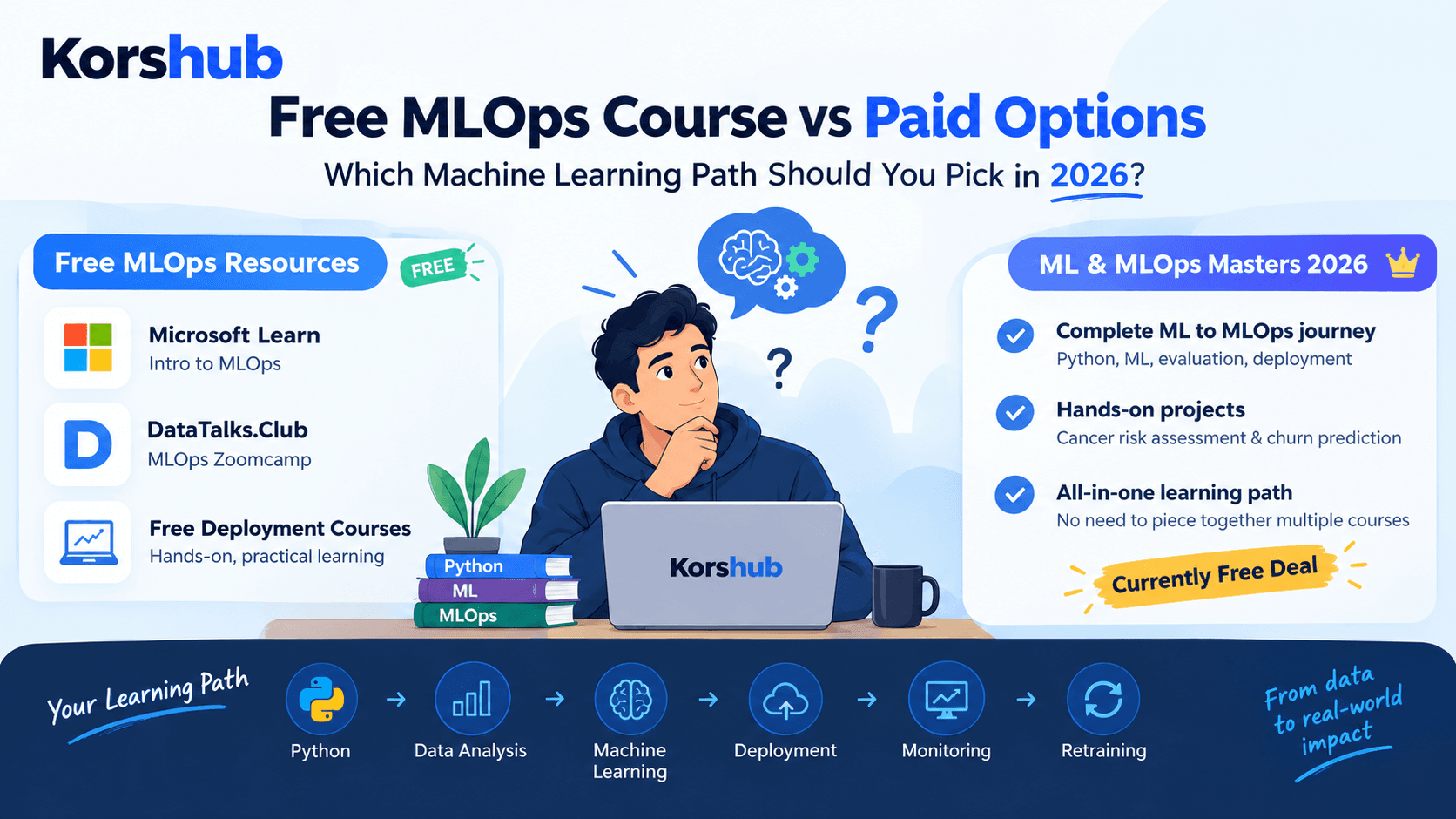
The good news? You don't necessarily need to pay to learn the basics. Microsoft Learn has a free introductory MLOps path, while MLOps Zoomcamp provides free materials covering production ML workflows. There are also free deployment-focused courses available online.
But free resources can become fragmented quickly. You might learn Docker in one place, MLflow somewhere else, and model monitoring from a third tutorial. If you want one structured path that starts with machine learning fundamentals and continues into MLOps, the ML & MLOps Masters 2026 course is currently listed on Korshub at a free deal price.
Advertisement
So, which route makes sense for you?
MLOps Course Options: Free vs Structured Learning
Here's the practical difference between the main routes.
Learning option | Cost | Main focus | Best fit |
|---|---|---|---|
Microsoft Learn MLOps | Free | DevOps principles, automation and deployment | Beginners exploring MLOps |
korshub MLOps Zoomcamp | Free | Productionizing ML services | Learners with ML basics |
Free deployment/MLOps courses | Free | Deployment, monitoring and CI/CD | Focused skill building |
ML & MLOps Masters 2026 | Currently free deal | ML fundamentals through MLOps | Learners wanting one broader path |
Microsoft's learning path is aimed at beginners and covers repositories, automation, Azure Machine Learning, Azure Pipelines and GitHub Actions.
The important distinction is breadth versus specialization.
What the ML & MLOps Masters 2026 course actually covers
The Korshub listing describes an all-level course that starts with Python, statistics, data preparation and exploratory analysis before moving into classification, regression, clustering and time-series forecasting. It then adds model evaluation, deployment, versioning, monitoring and retraining.
That makes it different from a short MLOps-only course.
You aren't starting with deployment tools and working backward. You're building the machine learning foundation first, then learning what happens when those models need to operate beyond the notebook.
The course also includes hands-on coding exercises, quizzes and project-based learning. Two highlighted projects are cancer risk assessment and churn prediction.
Free MLOps Course Alternatives Worth Knowing
If you're mainly interested in the operational side of machine learning, there are several legitimate free options.
Microsoft Learn
Microsoft's introductory MLOps path takes about two hours and covers how DevOps practices can be applied to machine learning projects. It includes source repositories, local development, automated ML workflows and continuous deployment.
It's useful when you want a concise introduction, particularly if you're already interested in the Microsoft/Azure ecosystem.
Free deployment-focused courses
There are also courses dedicated specifically to model deployment and monitoring. For example, one currently available free course covers MLflow, Docker, model serving, data drift, monitoring and GitHub Actions.
These can be excellent supplements when you already have your ML fundamentals down.
The Gap Most MLOps Roadmaps Miss
There's a common mistake in how people learn MLOps: they jump into infrastructure before they can properly evaluate a model.
That sounds backwards, but it matters.
If you don't understand data leakage, cross-validation, appropriate evaluation metrics, or the difference between classification and regression, deploying a model faster doesn't solve the underlying problem.
The Korshub course takes a broader route by putting statistics, EDA, model validation and core ML before its MLOps material. Its syllabus specifically mentions metrics, cross-validation, leakage prevention and model diagnostics.
That's a useful distinction for beginners and aspiring ML engineers. Production isn't just about keeping a model running. You first need to know whether the model deserves to be running at all.
Who Should Take an MLOps Course?
An MLOps course makes sense if you've reached the point where simply training models isn't enough.
You might be:
A beginner in machine learning who wants a broader roadmap from Python to deployment.
A data science learner who wants to understand what happens after model training.
An ML practitioner who wants to add deployment, monitoring and retraining skills.
A software developer moving into ML engineering who needs more exposure to the ML lifecycle.
A portfolio builder looking for projects that go beyond a notebook and accuracy score.
If you already know machine learning well and only need MLOps, a specialized free course such as MLOps Zoomcamp may be a more direct starting point.
If you need both ML foundations and MLOps in one curriculum, the broader Masters course is the more relevant route to investigate.
Is the ML & MLOps Masters 2026 Course Free?
At the time of checking, Korshub lists the ML & MLOps Masters 2026 deal price as Free, with the current deal subject to change. The page also shows a 5.0 rating from 13 reviews and 131 students at the time checked.
Because course coupons and availability can expire, it's worth checking the course page immediately before enrolling rather than assuming the same deal will remain active.
Check the current ML & MLOps Masters 2026 deal
Which MLOps Learning Path Should You Pick?
There's no reason to treat this as an either/or decision.
If you're starting from the beginning, build your foundation in Python → statistics → data preparation → machine learning → evaluation. Then add deployment and MLOps.
If you already know ML, you can skip the introductory material and go straight into production-focused learning with resources such as MLOps Zoomcamp or a dedicated deployment course.
For someone who wants the whole progression in one place, the ML & MLOps Masters 2026 course is worth checking while the current free deal is available. Its combination of core ML, evaluation, real-world projects and MLOps makes it broader than a short deployment-only course.
The real goal isn't simply finishing an MLOps course. It's being able to answer a much more useful question:
Can I take a machine learning model from data and experimentation to a system that can actually be deployed, monitored and improved?
That's the skill the roadmap should ultimately give you.
Frequently Asked Questions
What is the best free MLOps course for beginners?
There isn't one universal choice. Microsoft Learn provides a short introductory path, while broader options such as MLOps Zoomcamp are more production-focused and assume more existing knowledge.
Can I learn MLOps for free?
Yes. Microsoft Learn, Korshub and several other platforms provide free MLOps learning resources. The main challenge is usually not finding free material but organizing it into a logical progression from machine learning fundamentals to production.
What should I learn before MLOps?
Start with Python and basic machine learning, including data preparation, model training and evaluation. Familiarity with Git, command-line tools and containers is also useful when you move into production workflows.
Is MLOps useful for data scientists?
Yes. MLOps helps data scientists understand what happens after experimentation, including deployment, versioning, monitoring and retraining. These skills become particularly useful when models need to operate reliably outside a development environment.
What is the difference between machine learning and MLOps?
Machine learning focuses largely on building and evaluating models from data. MLOps extends that lifecycle into areas such as reproducibility, deployment, monitoring, automation and ongoing model management.
Is the ML & MLOps Masters 2026 course free?
Korshub currently lists the course at a free deal price, but course coupons can expire or change. Check the current course page for the latest price and availability before enrolling.