Machine Learning and Data Science Made Simple: A Practical Beginner’s Guide
Prabhat
Sep 21, 20267 min read11 views
Why Data Science and Machine Learning Matter in 2026
Data is everywhere, but raw data by itself does not create value. Businesses need people who can clean information, identify patterns, build useful models, and turn technical results into decisions. Current job-posting research continues to show strong demand for skills such as Python, machine learning, statistics, SQL, and data analysis. For example, one analysis of 6,582 data analyst and data scientist postings found Python in 38% of postings, machine learning in 37%, artificial intelligence in 30%, and statistics in 23%.
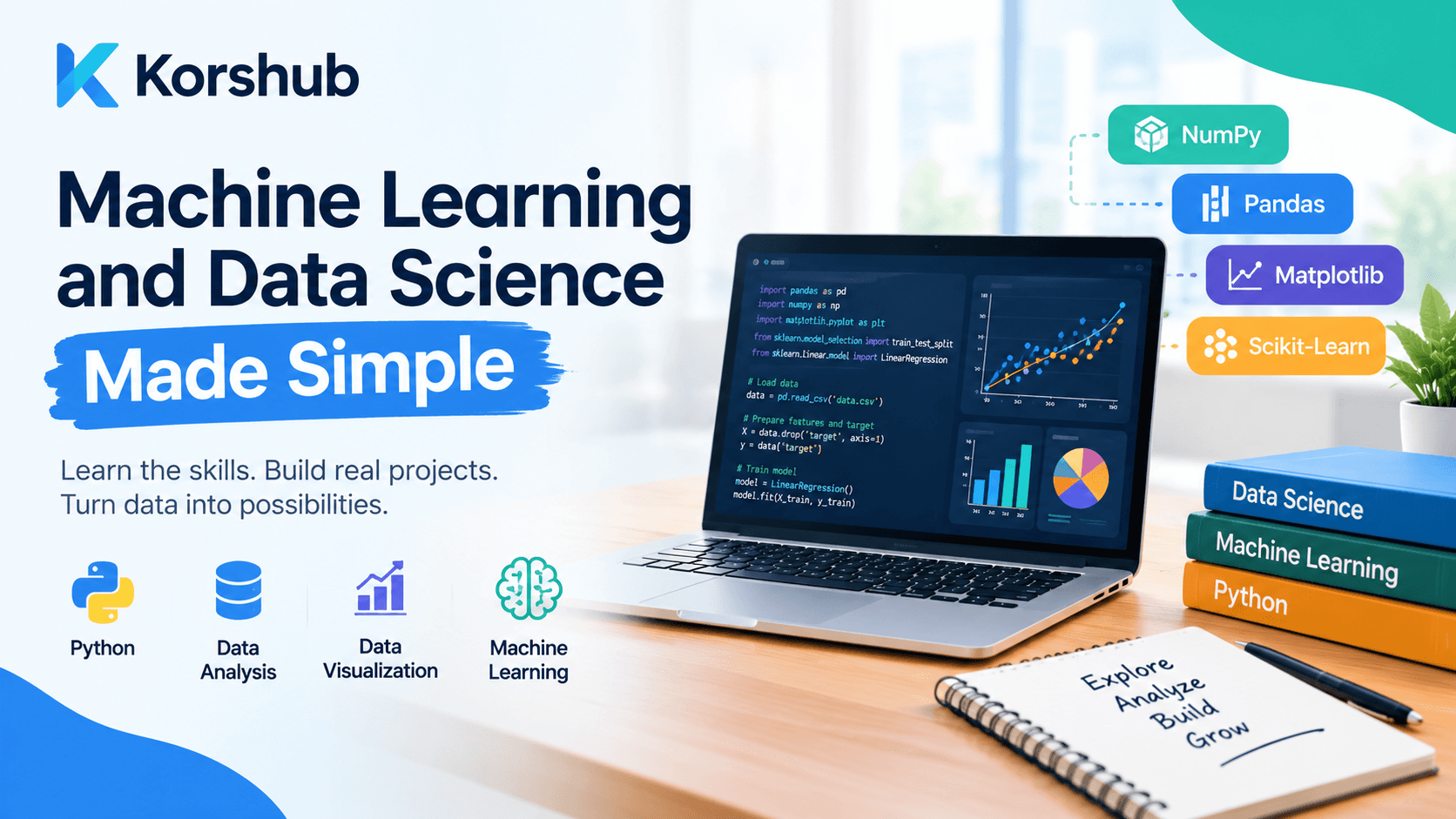
That makes Machine Learning and Data Science Made Simple a relevant learning path for someone who wants to understand these technologies without beginning with an overwhelming wall of mathematics and jargon. The course page describes it as suitable for all levels and focuses on practical learning with Python, Scikit-Learn, Pandas, NumPy, and Matplotlib. It also emphasizes moving from raw data through model development and evaluation.
Advertisement
What Is Data Science?
Data science is essentially the process of turning data into information that people can actually use. Imagine receiving a huge spreadsheet containing thousands of customer records. Looking at individual rows will not tell you much, but analyzing those records can reveal purchasing patterns, customer behavior, trends, and potential business opportunities.
A data science workflow commonly involves data collection, cleaning, exploration, visualization, statistical analysis, and modeling. Python has become particularly important in this workflow because its ecosystem gives learners practical tools for manipulating and analyzing datasets. Current job-market analyses continue to identify Python, SQL, statistics, and machine learning among frequently requested data-science skills.
What Is Machine Learning?
Machine learning takes the idea one step further. Instead of manually programming every possible rule, you provide an algorithm with data and allow it to learn patterns that can be used to make predictions or decisions.
For example, a machine learning model could study historical information about houses and learn relationships between features such as location, size, number of rooms, and selling price. Once trained, the model can estimate prices for new properties. The course specifically covers regression, classification, and clustering, giving learners exposure to several fundamental machine learning approaches.
Python for Data Science and Machine Learning
Python is one of the most practical starting points for people entering data science. Rather than learning a programming language in isolation, beginners can immediately use Python to work with real datasets, visualize information, and train machine learning models.
The course focuses on several important Python libraries. NumPy provides tools for numerical computing, while Pandas makes working with structured datasets much easier. Matplotlib supports data visualization, and Scikit-Learn provides widely used machine learning functionality. Learning how these tools work together helps turn Python from a general-purpose programming language into a practical data science toolkit.
Understanding Data Visualization
Numbers can be difficult to interpret when they are presented only as rows and columns. Visualization gives those numbers a shape that the human brain can understand more quickly. A chart can reveal a trend, unusual value, or relationship that might remain hidden inside a spreadsheet.
That is why visualization is an important part of a beginner-friendly data science workflow. Instead of simply calculating an average, learners can explore distributions and relationships visually before deciding what the data actually means. The course includes data visualization with Matplotlib as part of its practical curriculum.
Supervised and Unsupervised Learning
Two foundational concepts beginners encounter are supervised learning and unsupervised learning. In supervised learning, a model learns from examples where the expected outcome is already known. Regression and classification are common examples.
Unsupervised learning works differently. The data does not come with predefined answers, so the algorithm attempts to identify meaningful structures or groups within it. Clustering is a classic example. Understanding this distinction gives learners a foundation for recognizing which machine learning technique might fit a particular problem.
Regression and Classification
Regression is commonly used when the target is a numerical value, such as predicting revenue, temperature, or property prices. Classification is used when the objective involves categories, such as determining whether a transaction belongs to one category or another.
These concepts are important because they connect machine learning theory with practical problems. The course provides hands-on exposure to both regression and classification rather than keeping the discussion entirely theoretical.
Clustering
Clustering introduces another useful way of thinking about data. Instead of telling the model which group each record belongs to, you allow it to discover groups based on similarities within the dataset.
A business might use this type of approach to explore customer segments, for example. The important lesson for beginners is not simply memorizing an algorithm, but understanding why and when an approach can be useful.
Building Machine Learning Models
One of the strongest practical aspects of the course is its focus on the complete journey from raw data to predictive models. According to the course page, learners work with messy data, create models, and evaluate their performance rather than simply watching isolated demonstrations.
That project-oriented approach matters because machine learning rarely looks like a clean textbook example in real life. Data can contain missing values, inconsistent information, irrelevant features, or unexpected patterns. Learning to work through those issues is an important part of developing practical data science skills.
Model Evaluation and Performance
Building a model is only part of the process. You also need to understand whether its predictions are useful. Model evaluation helps determine how well a trained model performs and whether it generalizes beyond the data used during training.
This is an important distinction for beginners: a model producing predictions is not automatically a good model. Learning to evaluate performance encourages a more disciplined approach to machine learning and helps learners understand the difference between experimentation and reliable results.
Why Hands-On Projects Matter
Watching tutorials can make a subject feel easy because someone else is doing the difficult work. Projects change that dynamic. When you have to load a dataset, clean it, visualize it, select an approach, train a model, and interpret the results yourself, you start developing genuine problem-solving skills.
The course emphasizes hands-on coding and project-based learning, with the goal of helping learners progress from basic concepts toward practical predictive modeling. For someone building a portfolio, projects can also provide something more tangible than simply listing “machine learning” on a resume.
Who Can Learn Machine Learning and Data Science?
You do not necessarily need to be an experienced programmer or mathematician to begin exploring data science. The course is listed as all levels and specifically positions itself as an accessible starting point for beginners, career changers, aspiring data professionals, and curious learners.
That accessibility is useful because data science can initially appear intimidating. There are unfamiliar terms everywhere — algorithms, features, models, regression, classification, clustering, evaluation metrics, and more. A structured introduction can help turn those separate pieces into a connected learning journey.
Conclusion
Machine Learning and Data Science Made Simple offers a practical introduction to two closely connected fields. Its curriculum covers Python-based data handling, visualization, supervised and unsupervised learning, regression, classification, clustering, model evaluation, and project-based workflows.
For learners who want to move beyond theory, the emphasis on tools such as Python, Pandas, NumPy, Matplotlib, and Scikit-Learn provides a practical foundation. Current employment research also shows continued demand for several of these skills, particularly Python, machine learning, statistics, and data analysis.
The course is currently listed on Korshub with a 4.5 rating, 5K students, and an all-levels designation; its current Korshub listing also shows a free deal, although coupon availability can change.
FAQs
1. Is Machine Learning and Data Science Made Simple suitable for beginners?
Yes. The course is listed as all levels, and its description specifically focuses on simplifying machine learning and data science concepts through practical explanations and coding exercises.
2. What Python libraries are covered?
The course page identifies Scikit-Learn, NumPy, Pandas, and Matplotlib among the core libraries used in the learning process.
3. Does the course cover machine learning algorithms?
Yes. It introduces supervised and unsupervised learning and covers regression, classification, and clustering with hands-on coding.
4. Can this course help with practical machine learning projects?
The course emphasizes project-based learning and describes a workflow that takes learners from raw data through predictive models and performance evaluation.
5. Where can I find the course?
The course is available through the Korshub course listing, where its current deal and enrollment information are displayed. Machine Learning and Data Science Made Simple on Korshub