Udemy
 Udemy
UdemyPrice
No active coupon right now
View Course →No coupon right now. We'll tell you when there is one.
Mark your own learning status. Opening a course link does not establish enrollment.
There's no universal "best" enclosure—only the right choice for what you want to hear. This course teaches you to design one around your preferences: deep bass, high volume, smooth response, or whatever matters most for your application.
Starting from sound-wave fundamentals, you'll learn how speakers work, explore the common enclosure types, and focus on sealed and bass-reflex designs with extensive detail. Two practical tools are included: an Excel spreadsheet for quick modeling and calculations, plus guidance on the Subwoofer Design Toolbox software for deeper exploration.
Recent updates added two-way speaker build examples and crossover-design principles, making the course practical for hands-on builders. The approach is deliberately beginner-friendly—you control the sliders and make the acoustic trade-offs that matter to you, rather than following generic recipes.
Design an enclosure to match your preferences
The main purpose of this course is to teach you how to properly design an enclosure for your speaker. There is no such thing as "This enclosure is the best choice for this particular speaker". You have to take into consideration your application and your personal preferences. Do you want it to sound loud? Do you want it to sound deep and don't care about loudness? You want it to be as smooth and linear as possible? These are all just a few examples of questions that needs answering before you get to work. The final result will always be a compromise between the acoustical qualities of an enclosure. Only you can decide which sound qualities are more important to you and you should be the one who "moves the sliders".
Acoustics basics
This course assumes that you have minimal knowledge about acoustics, and therefore starts slowly with some basic information about sound waves, how they are created and what are their characteristics. Then moves on to how the speaker is designed and some other relevant information about acoustics. This is obviously needed for a beginner, but it's also good for an intermediate student, as I'm sure he will also find new information to make matters even more clear.
Enclosure types
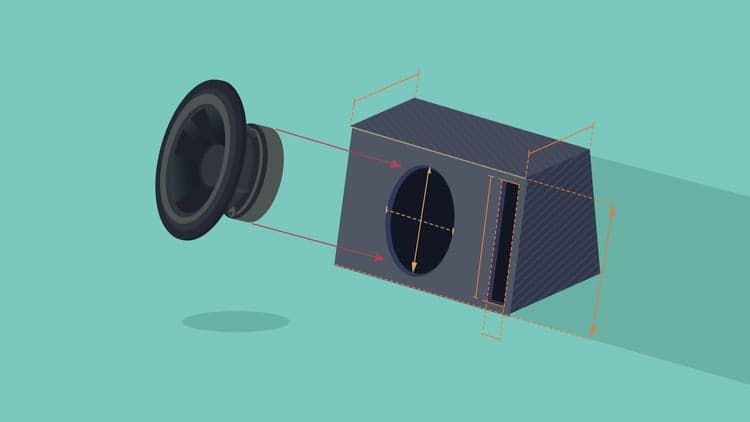
Most of the common enclosure types are listed, explaining their working principle, pro's and cons for each one. But, we will focus our attention for the sealed and bass reflex enclosures. These are covered with extensive details regarding their characteristics and how to design them according to the standard alignments, or to complete custom response curves.
Modeling software
To model the response curve of the enclosure and to calculate the dimensions of the box, two methods will be used. You will receive an excel spreadsheet, that has all that you need to model a sealed or a bass reflex enclosure with minimal difficulty. It even has a chart to show you the modeled frequency response. It's basically a complete package for a beginner. The other method is by using a paid application. There are a lot of speaker design software solutions out there but I chose : "Subwoofer design toolbox". The main reasons are : it's cheap, simple, easy to understand and it has all the basic functions. If you are a beginner it's very important to start slow, otherwise you will get overwhelmed by complicated applications with extra features that will only confuse you.
Nov 2017 Update - 2-way speaker build example and basic 2-way crossover design.
Jan 2018 Update - Added English subtitles.
Jul 2020 Update - Added more animation to some lessons.
Advertisement



This is what we recorded in US pricing — not every price this course has ever had, and prices differ by country.