Other
Free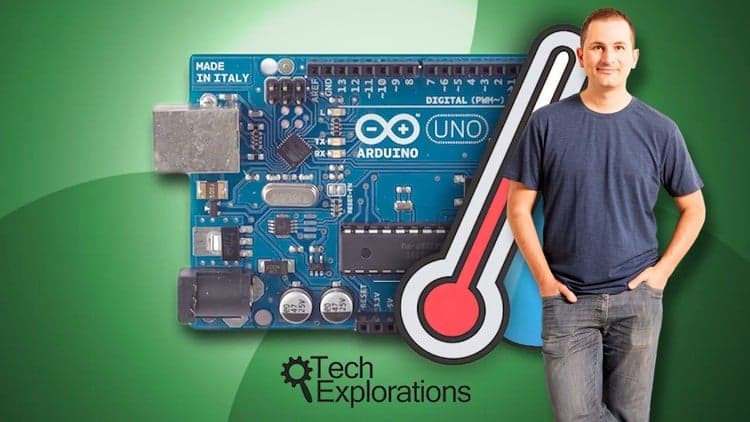
Price
No active coupon right now
View Course →No coupon right now. We'll tell you when there is one.
Mark your own learning status. Opening a course link does not establish enrollment.
Loading saved status…
Everything in the course builds toward one device: a monitor that measures temperature, humidity, air pressure and light, shows readings on an LCD and publishes the data to a cloud logging service. Learning is organized in three parts, moving from circuits to code to a complete connected build.
The course treats wiring mistakes and unexpected sensor behavior as a normal part of building hardware. It teaches a systematic approach to finding faults, which carries over to any electronics project you take on next.
Choosing and sourcing components is part of the process, including understanding specifications and equivalent parts. The hardware list is short: an Arduino Uno, a DHT22 and BMP085 sensor pair, a photoresistor, a 16x2 LCD, a potentiometer, a breadboard, resistors and jumper wires.
Learn Arduino by Building a Complete IoT Project
The best way to learn Arduino is by building a real project.
This course is designed for beginner Arduino learners and makers who already have a basic understanding of electronics. Together, we'll build a complete Arduino IoT environmental monitoring system while developing the practical skills needed to confidently tackle future electronics projects.
Using an Arduino Uno, you'll assemble electronic circuits, connect multiple sensors, display live measurements on an LCD, and publish environmental data to a cloud logging service so you can monitor your surroundings from anywhere. Rather than simply following instructions, you'll learn how each component works, why it is used, and how it contributes to the finished project.
Every lesson builds on the previous one, helping you understand not only what to do but also why you are doing it. This practical, project-based approach makes it easier to retain what you've learned and apply those skills to your own Arduino and IoT projects long after you've completed the course.
Building hardware doesn't always go exactly to plan, and that's part of becoming a maker and an engineer. Components sometimes behave unexpectedly, wiring mistakes happen, and software occasionally needs careful debugging. Throughout this course, you'll develop a systematic approach to solving these challenges, building the confidence, resilience, and growth mindset that every successful engineer relies on. Every obstacle is an opportunity to learn, improve, and become a more capable problem solver.
The course is organised into three progressive parts.
Part 1 introduces the Arduino platform and guides you through building your first circuits, giving you the confidence to begin creating your own projects.
Part 2 focuses on Arduino programming, the Arduino IDE, and the core concepts you'll need to control hardware, read sensors, and understand how your code interacts with the physical world.
Part 3 brings everything together as you build JING, your own Internet-connected environmental monitoring system. You'll assemble the hardware, write the software, and integrate each component step by step until you have a fully functioning IoT device.
Along the way you will learn how to:
Build Arduino circuits using commonly available electronic components.
Connect and program temperature, humidity, air pressure, and light sensors.
Display real-time sensor readings on an LCD.
Publish environmental data to a cloud logging service.
Develop practical Arduino programming skills through a complete project.
Troubleshoot hardware and software using proven engineering techniques.
Build the confidence to design and create your own Arduino and IoT projects.
One of the practical skills you'll develop throughout this course is learning how to source electronic components. Finding suitable hardware is part of the engineering process, and becoming familiar with suppliers, component specifications, and equivalent parts is a valuable skill that will benefit you well beyond this project. I'll explain the purpose of each component and help you understand why it has been chosen, so you can confidently source parts for your own future projects.
To get the most from this course, you should already have a basic understanding of electrical concepts such as voltage, current, and resistance, along with basic computer skills. Previous Arduino experience is not required, and while some programming experience is helpful, it is certainly not essential.
Hardware required
You'll need the following components to complete the project:
Arduino Uno (a genuine Arduino Uno is recommended)
DHT22 temperature and humidity sensor
BMP085 barometric pressure sensor
Photoresistor
16×2 HD44780-compatible LCD display
Breadboard
Potentiometer
Assorted resistors
Breadboard jumper wires
These components are inexpensive and readily available from electronics suppliers around the world.
Your instructor, Peter Dalmaris, is an engineer, educator, author, international conference speaker, and founder of Tech Explorations. He has taught hundreds of thousands of students through his practical, project-based courses. Peter is the author of Maker Education Revolution and the best-selling KiCad Like a Pro series, trusted by makers, students, educators, and professional engineers worldwide. He has been a featured speaker at Elektronika with Elektor, Maker Faire Athens, and KiCon Asia in Shenzhen, where he has shared his expertise with the global engineering, electronics, and maker communities. His teaching philosophy is simple: the best way to learn engineering is by building real projects, understanding how they work, and developing the confidence to solve problems independently.
Whether you're taking your first steps with Arduino or expanding your electronics skills into IoT, you'll finish this course with much more than a completed project. You'll have developed practical engineering skills, a structured approach to problem solving, and the confidence to continue designing, building, and troubleshooting your own Arduino and IoT projects for years to come.
Advertisement
Tracking since 15 Nov — not enough history yet to tell you whether today's price is any good. Watch the course and we'll tell you when it drops.
This is what we recorded in US pricing — not every price this course has ever had, and prices differ by country.
No Korshub reviews yet.