Other
Free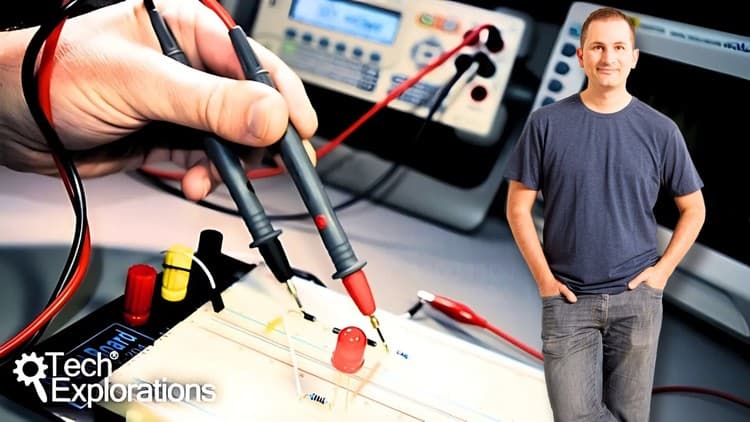 Udemy
Price
No active coupon right now
View Course →No coupon right now. We'll tell you when there is one.
Mark your own learning status. Opening a course link does not establish enrollment.
Loading saved status…
This course targets people who can follow Arduino guides and edit sketches but feel shaky on the electronics underneath. Topics such as transistor currents, voltage drops and capacitor filtering are the focus, since they decide whether a circuit behaves as intended.
New lectures introduce an online circuit simulator. You can run experiments on different circuit scenarios, use multiple power sources and plot currents, voltages and power without buying extra hardware. The simulator also lets you test situations that would be unsafe to build on a bench.
Most of these parts will already be familiar to anyone who has built Arduino projects.
I have updated this course with new lectures to teach you how to use an online circuit simulator. With this simulator, you can boost your understanding and learning of electronics. You will be able to conduct many experiments to examine multiple circuit scenarios and easily plot currents, voltages, and power without hardware expense. You will learn to use multiple power sources and built-in and custom component models. You can even conduct experiments that would be too dangerous to do in real life.
-
Are you an Arduino maker? Can you make things by following how-to guides and are confident with writing or modifying sketches? Yet you are not so confident about things like calculating transistor currents, voltage drops, and using capacitors as filters?
You are not alone. I have been teaching Arduino and Raspberry Pi topics for years. During this time, I realized that while these platforms are great for helping you start tinkering with electronics, you will not be able to enjoy their power until you truly understand basic electronics.
This course is about helping you achieve a better understanding of the basic electronics principles and components commonly used in making platforms like Arduino and Raspberry Pi.
I have designed this course for anyone with a basic understanding of electronics who has already spent time tinkering with Arduinos.
By the end of this course, you will have learned how to use commonly used components found in Arduino projects. You will also have learned how to do the relevant measurements and calculations to help you select appropriate components for your projects.
To complete this course, you will need a few cheap and common components and tools: resistors, capacitors, transistors, LEDs, diodes, and batteries. You will also need a multimeter, a small breadboard, and jumper wires. All of these are probably things that you already have.
Advertisement
Tracking since 15 Nov — not enough history yet to tell you whether today's price is any good. Watch the course and we'll tell you when it drops.
This is what we recorded in US pricing — not every price this course has ever had, and prices differ by country.
No Korshub reviews yet.