Udemy
 Udemy
UdemyPrice
No active coupon right now
View Course →No coupon right now. We'll tell you when there is one.
Mark your own learning status. Opening a course link does not establish enrollment.
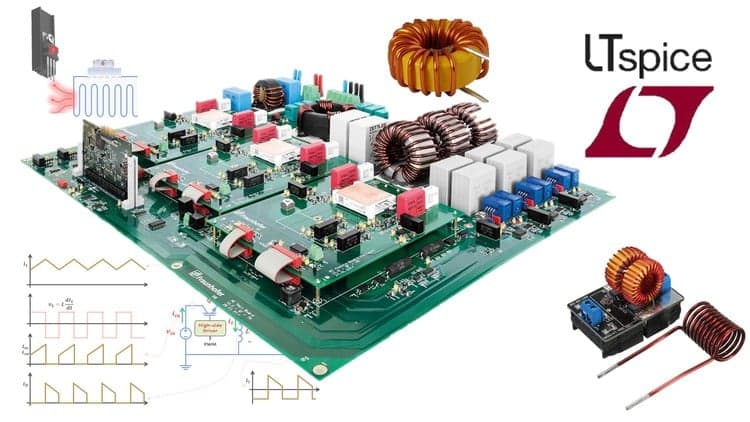
This course bridges hand calculation and simulation reality. You'll learn three switch technologies (Silicon, Silicon Carbide, Gallium Nitride), analyze power dissipation and thermal stress across different waveforms, and size heatsinks to decide whether active cooling is needed. Then you move to DC/DC converters (Buck, Boost, Buck-Boost) and inverters, deriving steady-state equations and validating them in LTSpice.
Problem sets and labs reinforce each step. The final project—designing a closed-loop Buck converter—ties theory to practice and prepares you for more advanced electronics work.
This course introduces you to the basics of Power Electronics including switches, Inverters, DC/DC converters and all that supported by LTSpice. We cover here how to calculate the power dissipation and thermal stresses for different groups of waveforms on switches by hand and using LTspice. That includes sizing the heat sink and enabling you to decide whether active cooling is required. We introduce you to Silicon, Silicon Carbide and Gallium Nitrate switches and the main differences to enable you to choose the best for an application. You will be able to analyse the DC/DC Converters: Buck, Boost, Buck-Boost and inverters and understand how the current flows in a circuit and to derive the steady state relations between the input and the output.
LTSpice is used to validate the calculation and help to calculate a converter efficiency. We use LTSpice to design a closed-loop Buck converter. All that is supported by problem sets and labs. Problem sets are a group of problems that we supply for you to practice your understanding and we supply also the solutions. For the labs we introduce you to some tasks that will help you to conquer LTspice.
We are expecting you to engage totally with the course and give enough time to understand each part and practice the problem sets. I am confident that will be an excellent course for you to understand any more advanced topics in power electronics.
Advertisement


Not the best price we've seen. The lowest we've recorded is $10.99 on 18 Aug.
This is what we recorded in US pricing — not every price this course has ever had, and prices differ by country.