Udemy
Free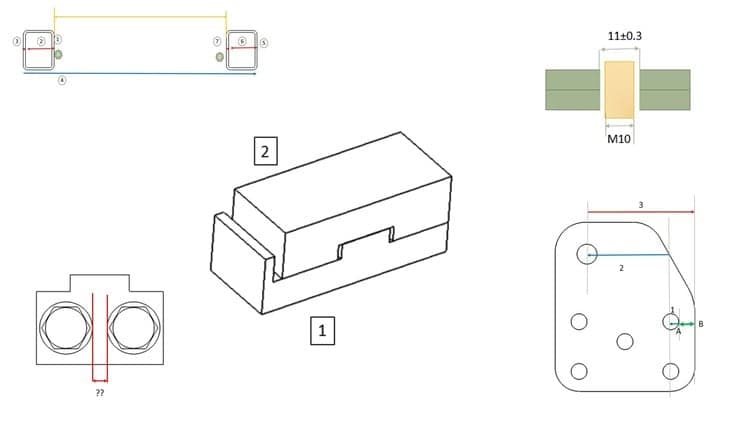 Udemy
UdemyPrice
No active coupon right now
View Course →No coupon right now. We'll tell you when there is one.
Mark your own learning status. Opening a course link does not establish enrollment.
In mechanical design, tolerances aren''t bureaucratic overhead—they''re directly tied to whether your product works and costs what you promised. Small dimension variations compound across assemblies, and this course teaches you to anticipate and control that cascade.
You''ll learn what tolerance is, where variation comes from, and how to interpret and specify fits. Loop diagrams, assembly-shift calculation, and the marriage of tolerance stack-up with geometric dimensioning and tolerancing (GD&T) form the technical core. The course also covers statistical tolerancing: when worst-case analysis is overkill and when process capability becomes the real metric.
The progression is methodical, with clear explanations at each step. You''ll move from simple stack-up procedures to boundary conditions that account for both size and positional variation. By the end, you''ll possess the foundation mechanical engineers need to design parts that are manufacturable, reliable, and economical.
Understanding Tolerances and tolerancing schemes is a very important part of Mechanical design .
In most cases Tolerances are directly detrimental to the functional performance of a mechanical product.
This course attempts to cover the key concepts in tolerance stackup , limits, fits and statistical tolerancing with examples .
Tolerance stackup analyses are critical in applications where small changes in dimension of parts can have heavy consequences.
What we will cover in the course?
What is tolerance? What are sources of variation ?
What are Fits , the nomenclature, types and Tolerance zones
How to decode and interpret a Fit specification and convert it into limits
How to Define a specification of a Fit for a specific application
How to do a simple tolerance stackup ? Generic procedure and factors to be considered?
How to develop Loop Diagrams in Stackup ?
Assembly shift in Tolerance analysis
How is assembly shift calculated
Stackup with GD&T
How to find Boundary conditions accounting for size and positional variations
How to derive the individual specifications in tolerance table
How to develop the envelopes for GD&T controls
Statistical Tolerancing
Why Statistical techniques are used?
What is normal distribution
What is difference between worst case and statistical analysis
What is Process capability index
The course is structured to provide learning in a methodical step by step way with clear explanations .
Core Learning outcome is to provide a strong foundation concept in Tolerance analyses for mechanical Engineers in design and manufacturing.
Advertisement

Not the best price we've seen. The lowest we've recorded is $9.99 on 17 Aug.
This is what we recorded in US pricing — not every price this course has ever had, and prices differ by country.