Coursera
Subscription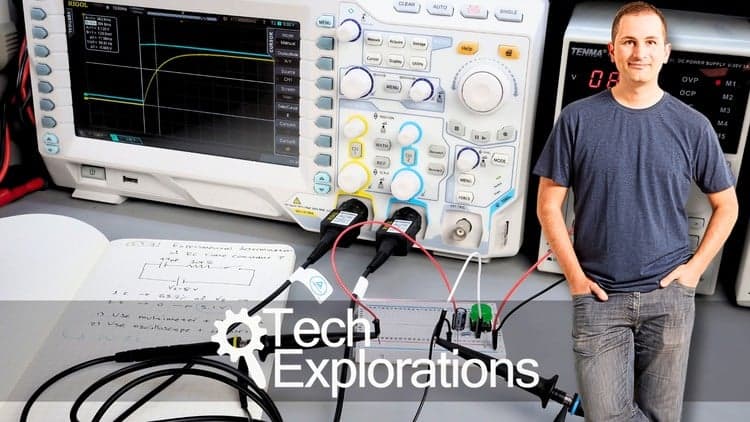 Udemy
Price
No active coupon right now
View Course →No coupon right now. We'll tell you when there is one.
Mark your own learning status. Opening a course link does not establish enrollment.
Loading saved status…
Beginners often jump straight to Arduino or PCB projects before the underlying circuit ideas feel solid. This course starts with voltage, current, resistance and power, then works through Ohm's Law, series and parallel networks, and analysis methods such as Kirchhoff's Laws and Thevenin's Theorem.
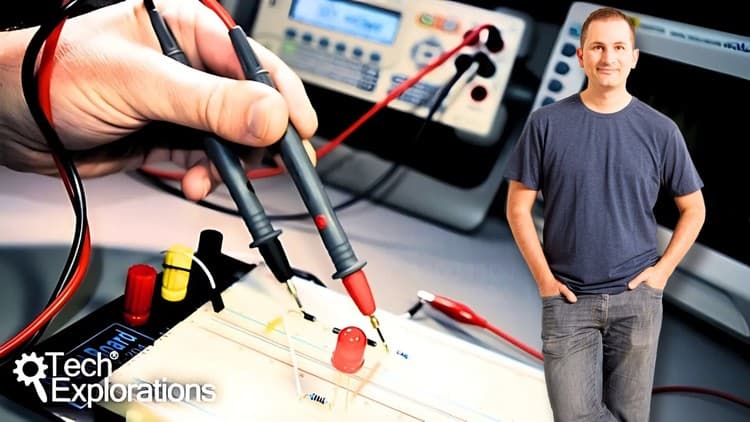
Much of the teaching is hands-on. Breadboards, a digital multimeter, an oscilloscope and a function generator all feature in the workflow, alongside circuit simulation software so ideas can be tested before anything is wired up.
The instructor treats troubleshooting as part of the learning. Compare calculations with measurements, change one variable at a time, and resist reaching for the answer too quickly.
Introduction to Electronics: A Beginner's Course
If you want to build electronic projects, sooner or later you'll need to understand how electronic circuits work.
Whether your interest is Arduino, Raspberry Pi, robotics, PCB design, embedded systems, or electronics as a hobby or career, everything begins with the fundamentals. Understanding voltage, current, resistance, and power will make every future project easier to design, build, and troubleshoot.
This course was created to give you that foundation.
We'll start at the beginning with the basic concepts of electricity and electronic circuits. From there, we'll gradually build your knowledge and practical skills through a combination of clear explanations, worked examples, circuit simulation, mathematical analysis, and hands-on experiments.
Electronics is a practical subject. Reading about circuits is useful, but you'll learn far more by building them, measuring them, and understanding why they behave the way they do. Throughout this course you'll work with breadboards, electronic components, a digital multimeter, circuit simulation software, an oscilloscope, and a function generator to reinforce the concepts you learn.
Along the way you'll learn how to:
Understand voltage, current, resistance, and power.
Apply Ohm's Law and Watt's Law to real circuits.
Build and test circuits on a breadboard.
Measure voltage, current, and resistance safely with a digital multimeter.
Analyse series and parallel circuits, voltage dividers, and current dividers.
Apply Kirchhoff's Laws, Thévenin's Theorem, Norton's Theorem, Superposition, and Maximum Power Transfer.
Understand capacitors, inductors, and AC circuits.
Work with diodes and bipolar junction transistors (BJTs).
Use circuit simulation software to test ideas before building them.
One of the goals of this course is to help you develop the mindset of an engineer.
Building and testing electronic circuits isn't always straightforward. Sometimes a circuit won't work the first time, your measurements won't match your calculations, or you'll spend time tracking down a simple wiring mistake. That can be frustrating, but it's also a normal part of engineering.
Rather than seeing these moments as setbacks, I encourage you to see them as opportunities to learn. Every problem you investigate, every measurement you take, and every fault you diagnose strengthens your understanding and builds your confidence.
Take the time to think through problems methodically. Compare your calculations with your measurements, check your wiring carefully, and change one thing at a time. Resist the temptation to immediately search online or ask AI for the answer. These tools can be useful, but they can also rob you of the opportunity to develop the judgement and problem-solving skills that every engineer relies on. Learning to investigate, test, and persevere is one of the most valuable outcomes of this course.
The course contains more than 140 lectures, practical demonstrations, simulations, worked examples, quizzes, and downloadable resources. Each topic builds naturally on the previous one, allowing you to steadily develop your understanding without feeling overwhelmed.
I'm Dr Peter Dalmaris, an educator and engineer who has taught hundreds of thousands of students around the world. I'm the author of Maker Education Revolution and the bestselling KiCad Like a Pro series, and I've presented at Elektronika with Elektor, Maker Faire Athens, and KiCon Asia. My goal is simple: to help you understand not just how electronic circuits work, but why they work.
Whether you're a maker, student, hobbyist, STEM educator, or aspiring engineer, this course will provide a solid foundation for future learning in Arduino, embedded systems, robotics, PCB design, and electronics engineering.
I look forward to helping you begin your journey into electronics.
Advertisement
Tracking since 15 Nov — not enough history yet to tell you whether today's price is any good. Watch the course and we'll tell you when it drops.
This is what we recorded in US pricing — not every price this course has ever had, and prices differ by country.

No Korshub reviews yet.