Udemy
 Udemy
UdemyMark your own learning status. Opening a course link does not establish enrollment.
Frustrated by tutorials that show a breadboard being populated with no explanation of what's happening or why, the instructor built this course to actually teach analog electronics, not just demonstrate it. Instead of abstracting circuit behavior away with a microcontroller like an Arduino, the course goes straight to the components: resistors, diodes, capacitors, transistors, and integrated circuits, and how they work together to shape a signal.
The framing throughout is conceptual as well as mathematical, aiming to build real understanding of each component's role in a circuit, the same kind of knowledge behind analog gear like guitar effects pedals.
Best for: complete beginners curious about analog electronics who want a real conceptual foundation before diving into more advanced circuit design.
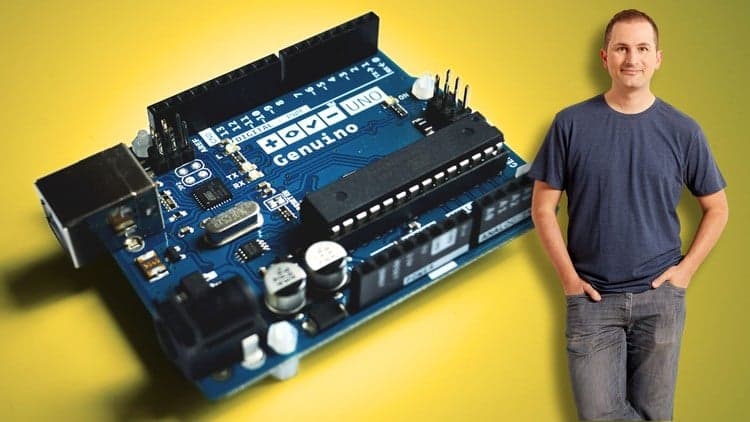
Years ago I bought an Arduino and I can remember how awesome it felt to hook it up, write a program, and blink an LED! My next question was "How on earth would you do that without an Arduino?!?". Don't get me wrong, I think Arduino's and all sorts of microcontrollers are awesome, but to me, it abstracted things a little too much. I'm an avid guitarist and a gear head; I love guitar effects pedals. Inside those stomp boxes, you won't find an Arduino. What you will find is the guts of an analog circuit: resistors, diodes, capacitors, transistors, and integrated circuit chips...all working together to create, bend, and shape a waveform.
I know there are tons of YouTube videos out there showing various analog circuits but the vast majority of them are the same: a time lapsed video of someone populating a breadboard or PCB with music playing in the background. No explanation of what they were doing or why they were doing it, no breakdown of the role of each and every component in the circuit, no conveying of understanding at not just a mathematical level but even a conceptual level. That is not learning and as someone who wanted to learn, to dive deeper into the subject, so I could figure out how to blink an LED without an Arduino and eventually more, it was a frustrating experience.
These are the reasons I decided to create this course. These are the reasons I hope you enroll in this free course; because I can help lift those learning frustrations for you and help you gain an appreciation for analog electronics.
By the end of this course, I hope for two things:
You will want to continue learning about electronics and enroll in my full course!
Have the confidence and knowledge to begin making your own basic electronic circuits!
Good luck and I hope to see you in our next video!
Advertisement

Electrones en Acción: Electrónica y Arduinos para tus propios Inventos