Udemy
Free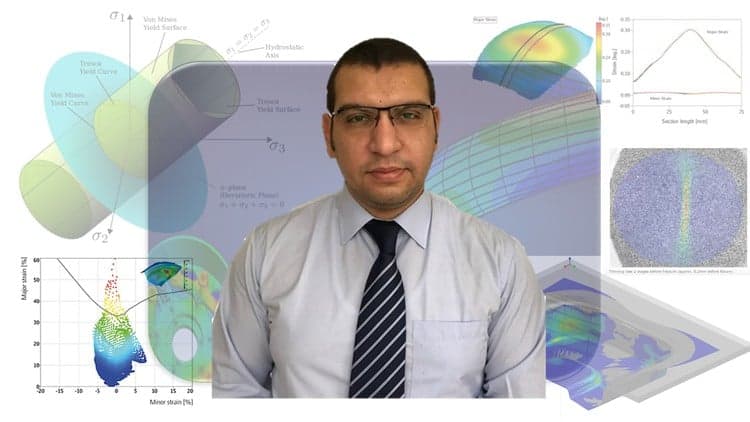 Udemy
UdemyMark your own learning status. Opening a course link does not establish enrollment.
This six-lecture course is aimed squarely at engineers who already work inside FE-solvers and need a firmer grip on why a material fails, not just how to run the software. It opens with the fundamentals — stress-strain curves, the difference between true and engineering data, and the classical theories of elastic failure — before moving into the forming-limit diagram, major/minor strain, and the Nakajima test referenced against the ISO12004 standard.
The back half is genuinely applied: interpreting forming-limit data and using it to evaluate a real deep-drawing process simulated in LS-DYNA, alongside supporting formability and triaxiality graphs. Each lecture ships with attached reference material, and the course is designed to sit alongside the instructor's companion titles on mechanical design and Ansys explicit dynamics.
Best suited to mechanical/manufacturing engineers and simulation specialists who want the material-failure theory behind their FE-solver workflow made explicit.
This course introduces a comprehensive discussion for material failure criteria
The course consists of six lectures.
The course is thought to be helpful for those who uses FE-solvers for the simulation of various metal forming processes.
The theoretical background is combined with practical implementation by the end of the course.
[Lec1 and Lec2]: Stress strain curve, true and engineering data, various types of stresses, and theories of elastic failure.
[Lec3 to Lec6]: Forming limit diagram, major and minor strain, Nakajima test, ISO12004, data interpretation, Application on deep drawing process simulation on Lsdyna.
Through those lectures, the failure criteria suitable for each case is introduced.
As one of the targets of this course is to qualify the attendees to be professional users for simulation software, the last lecture focuses on how the forming limit diagram can be used to evaluate a deep drawing process simulated on one of the famous FE-solvers which is Lsdyna. Other graphs such as formability and triaxility are introduced.
Useful material is attached with each lecture for students to help them to cope with the recording.
The course in general is integrated to our course in Udemy titles "Mechanical design a comprehensive course" and also "Ansys explicit dynamics course", which is prepared to be in English soon.
Advertisement


The Complete Fire Fighting with AutoCAD,Elite,Excel & NFPA