
Udemy
 Udemy
Price
No active coupon right now
View Course →No coupon right now. We'll tell you when there is one.
Mark your own learning status. Opening a course link does not establish enrollment.
Loading saved status…
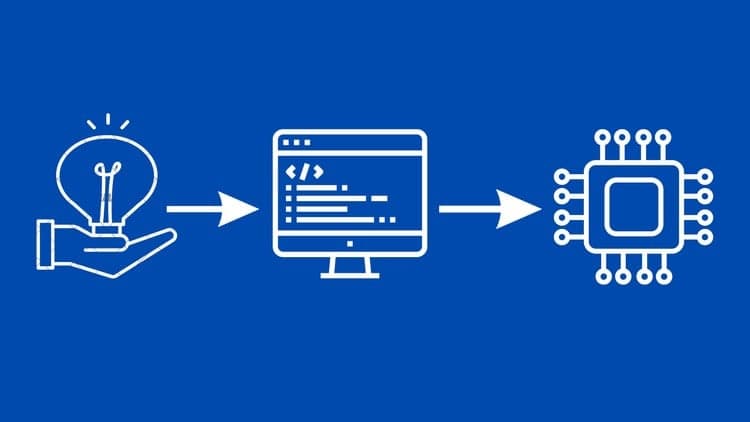
The course builds from transistor fundamentals up to layout. It opens with the design flow and the behavior of PMOS and NMOS devices, then moves through the inverter families that underpin later circuits.
The modules are updated regularly, and the reference text cited is Rabaey's Digital Integrated Circuits.
Welcome to my course on 'VLSI Design'. The course will help you to understand the different design methodologies, rules that are used in the field of VLSI Design.
The course essentially holds 7 different modules.
1. Fundamentals - Introduction to VLSI Design, The VLSI Design Flow, A review on PMOS, NMOS Transistors.
2. Inverter design - CMOS, Ratioed, Resistive Load Inverters - Working, VTC, Power, Delay
3. Logic design - Complementary CMOS, Pass Transistors, Transmission Gates
4. Dynamic circuits design - Precharge, Evaluation Phases, Characteristics, Dynamic Power Consumption
5. ALU Subsystem design - Adders, Shifters, Multipliers, Latches, Flipflops, Multiplexers and so on,
6. Memory Design - Fundamentals, ROM Cell, RAM Cell - SRAM, DRAM
7. Layout Design - CMOS Layouts, Mead-Conway rules.
All these modules will be frequently updated with new learning contents.
Very-large-scale integration (VLSI) is the process of creating an integrated circuit (IC) by combining thousands of transistors into a single chip. VLSI began in the 1970s when complex semiconductor and communication technologies were being developed. The microprocessor is a VLSI device.
Over the past several years, Silicon CMOS technology has become the dominant fabrication process for relatively high performance and cost effective VLSI circuits. The revolutionary nature of these developments is understood by the rapid growth in which the number of transistors integrated on circuit on single chip.
References:
Digital Integrated Circuits, A Design Perspective by Jan M. Rabaey, Prentice Hall (1996).
Advertisement



Tracking since 15 Nov — not enough history yet to tell you whether today's price is any good. Watch the course and we'll tell you when it drops.
This is what we recorded in US pricing — not every price this course has ever had, and prices differ by country.
No Korshub reviews yet.